

From Monday, 10 August, the municipality of Ungheni opens its public offer of municipal bonds worth 10 million lei — the loan with which it aims to repair part of its streets. In July, when we first explained the issue, the terms were still only draft. Now they are firm: on 4 August, the National Commission for Financial Markets (CNPF) approved the offer prospectus, and the exact figures are public.
Three classes of bonds, three interest rates
The issue means 10,000 bonds, each with a nominal value of 1,000 lei, split into three classes with different maturities and interest rates:
- Class I — 3,000 securities, over 2 years, with a fixed interest rate of 9.50% per year;
- Class II — 5,000 securities, over 3 years, with a fixed interest rate of 10% per year;
- Class III — 2,000 securities, over 4 years, with a floating interest rate, tied to the average yield of state treasury bills over 182 days, plus a fixed margin of 0.5 percentage points.
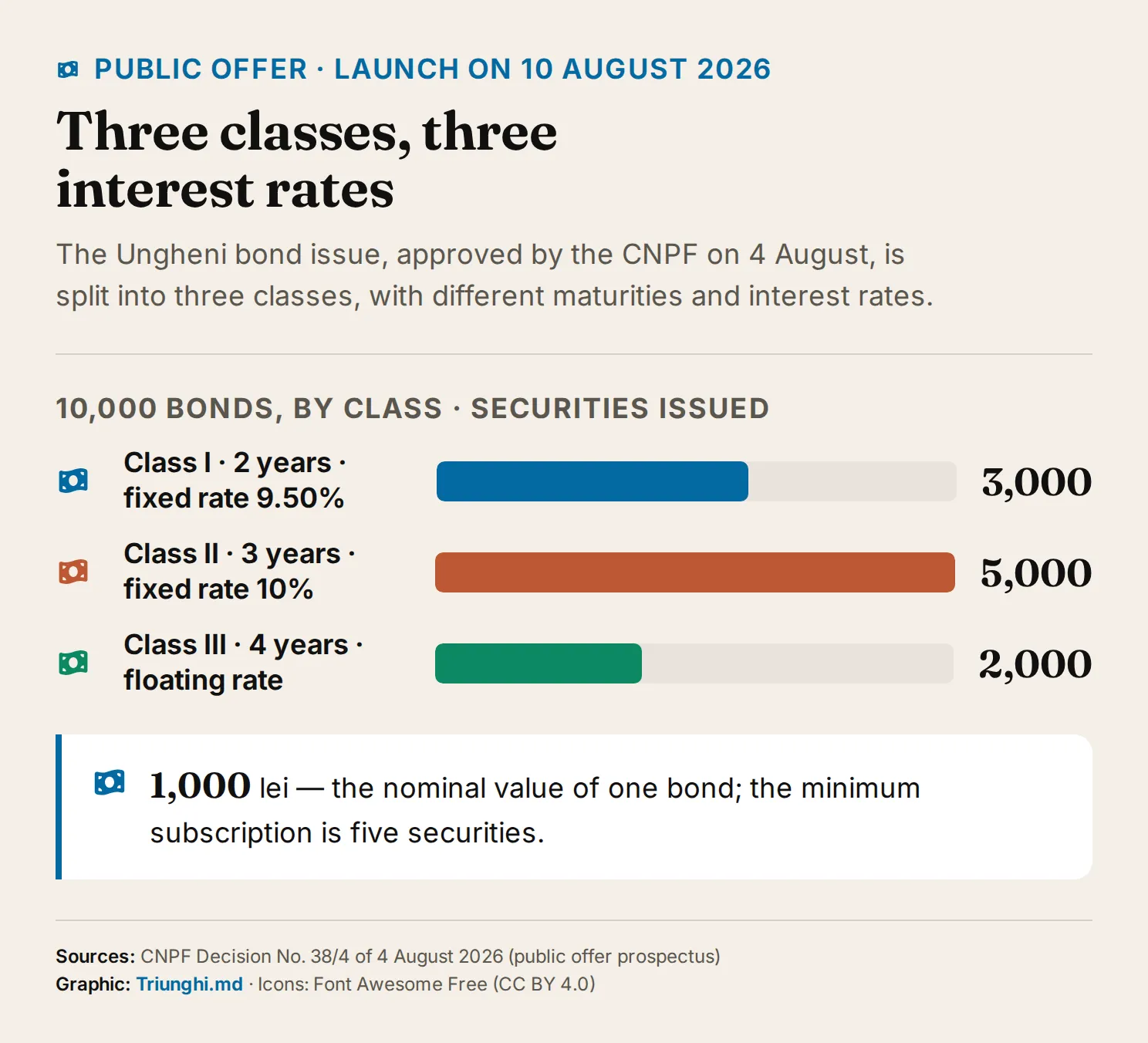 The three classes of Ungheni municipal bonds, by number of securities, maturity and interest rate. Chart: Triunghi.md. Source: CNPF Decision No. 38/4 of 4 August 2026.
Interest is paid every six months. The securities are guaranteed by the city hall’s revenues — those of the administrative-territorial unit. The confirmed structure is therefore richer than the figure circulated over the summer: ‘10%’ was, in fact, only the interest of the second class, and ‘three years’ — only the median maturity.
What it means for an Ungheni resident
The most important thing for an ordinary resident is the entry threshold. One can subscribe from five bonds, that is 5,000 lei — and, in the first two working days, the offer is reserved exclusively for individuals. Only from the third day do legal entities — companies and institutions — come into play. Someone who places 5,000 lei in the second class would receive, roughly, around 500 lei in interest per year — more than on a bank deposit. Unlike a deposit, however, the bonds are not covered by the Deposit Guarantee Fund, and the money returns, over time, from the local budget.
The subscription is intermediated by Victoriabank, and allocation follows the ‘first come, first served’ principle. According to the prospectus, the offer runs for 30 calendar days, in the days immediately following the offer announcement — the exact calendar dates are to be communicated by the intermediary. The launch itself is marked on Monday, 10 August, by an event in Chișinău organised by Expert-Grup, where Ungheni presents its issue alongside Leova, which is issuing 9 million lei in bonds in parallel.
Where the money goes
The destination of the 10 million is a list of streets, approved by the Municipal Council back in May. The stakes are high for a city where, according to the city hall, the street network exceeds 133 kilometres, of which more than 66 kilometres need asphalting. The contracting of the loan was approved by the councillors on 24 July, with the positive opinion of the Ministry of Finance on debt sustainability.
The issue remains, ultimately, a debt: the interest and the principal are repaid, in the following years, from the local budget — that is, from the contribution of Ungheni residents. How the instrument works in detail, what risks it carries and why Ungheni is becoming one of the largest municipal issuers outside the capital, we explained at length in the article about the launch of the issue.