

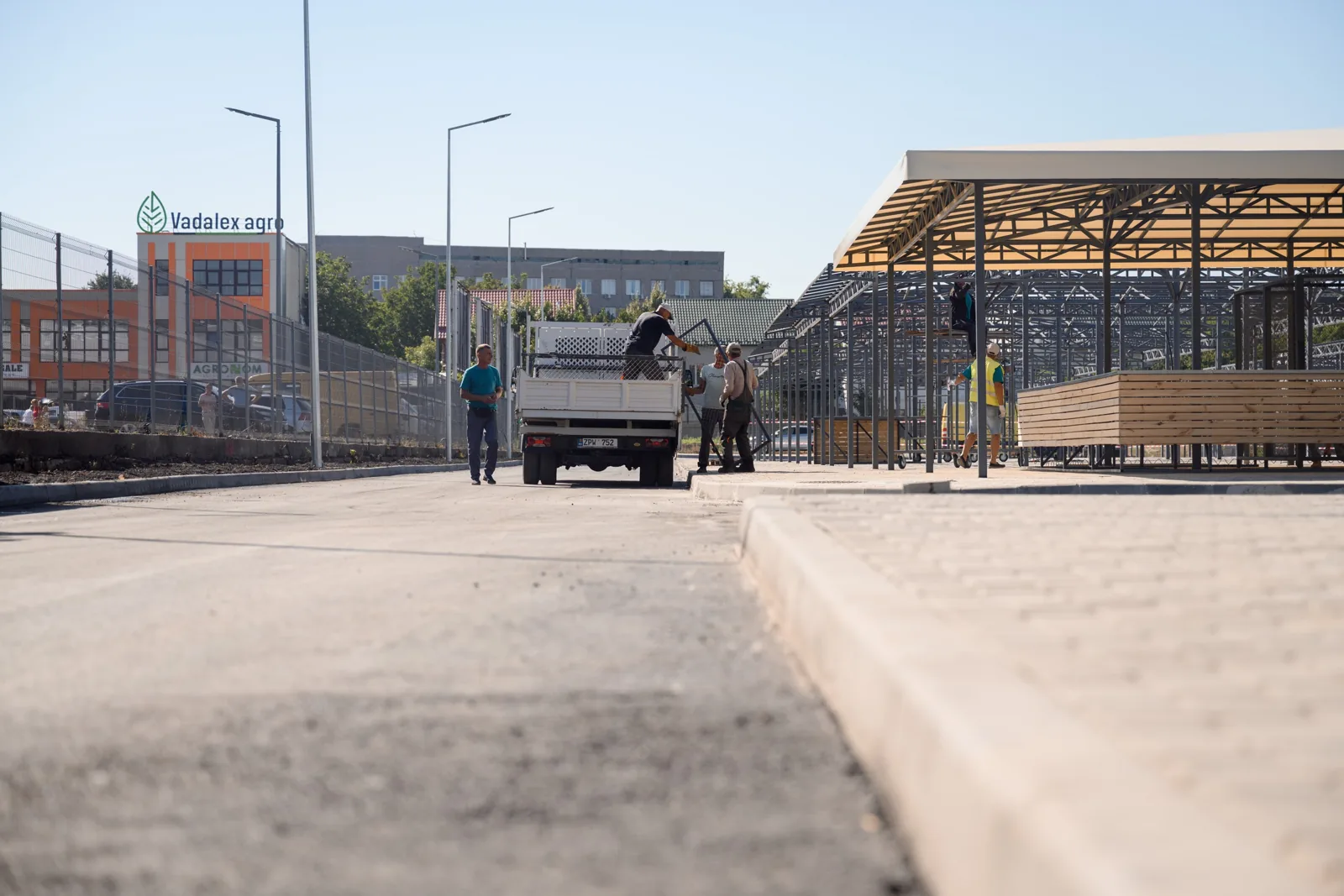
On 21 August 2026, by Decision No. 4, the Ungheni Municipal Council adopted the launch of a public consultation on the operating concept of the new agri-food market on Decebal Street. The consultation is open, and residents can submit their opinions until 21 September 2026, 10
a.m.What is being proposed
The City Hall puts forward for discussion an operating schedule of 5 days per week: Tuesday through Saturday. The proposal:
- Tuesday–Saturday — trading days. Saturday, a day off for most residents, would be a full market day.
- Sunday — a day of rest, with no commercial activity.
- Monday — sanitary day: general cleaning, disinfection, maintenance, preparation for the following week.
The explanatory note published by the City Hall states that the new market “must represent not just a modern building, but also the beginning of a modern concept of organising trade”. The City Hall argues that Sunday would gradually become a day devoted to family and community, while the Monday sanitary day would ensure “cleanliness, hygiene, food safety and proper conditions”.
A key element of the proposal: 5 days is more than the roughly 2 days of trade that the stalls at the old site offered. According to the City Hall, the proposed schedule would widen access both for buyers and for traders who currently “sell their products on the roadside”.
The specific timetable for those 5 days — opening and closing hours — is not yet set out in the explanatory note.
How to participate and by when
Opinions can be submitted in three ways:
- A comment or message on the Ungheni City Hall Facebook page
- E-mail to primaria.municipiul-ungheni@apl.gov.md
- A comment on the City Hall website page (login required)
Deadline: 21 September 2026, 10
a.m. The full explanatory note is published on the City Hall website, under Announcements.Mayor Vitalie Vrabie publicly stated that he supports the initiative, “convinced that the new operating schedule will bring order, hygiene and better conditions for traders and buyers, as well as respect for time devoted to family”.
What questions the proposal raises
Two aspects of the explanatory note remain open for discussion:
Access from villages. The proposal envisions Saturday as a full trading day — a sufficient argument for city residents, but not necessarily for producers and buyers from the district’s rural communities, who have different work and travel rhythms. Ungheni’s market day has traditionally gathered producers from across the district’s villages.
Opening hours. The note sets the days but not the time slots. For traders who travel from a distance, the opening and closing times matter as much as the day itself.
What the law says about how a market works
A market’s rules are not written on a blank page. They have a national framework, in Law No. 231/2010 on internal trade and in Government Decision No. 206/2023, which set out a few things worth knowing before any discussion on rules:
- The market is created by a decision of the local council, and its regulation is likewise approved at this level. Ungheni is following this path.
- The administrator may be the city hall itself, a municipal enterprise or an economic operator. Who will manage the new market is one of the substantive decisions of the concept.
- At least half of the commercial area of an agri-food market is reserved, by law, for domestic producers, on the basis of a producer’s declaration. Spots for itinerant trade are allocated daily, on a “first come, first served” basis. For Ungheni, where market day gathers producers from the district’s villages, this is a provision that matters directly.
- The tariffs for the market’s services are set by the administrator, coordinated with the city hall, on principles of transparency and non-discrimination. The law, however, prohibits charging any payment for mere access to the market.
- A detail often confused: the market’s tariffs (set by the administrator) are not the same thing as local taxes — the market tax and the tax on commercial units, which the council votes together with the budget. These are different payments, with a different regime.
The framework regulation on which all this rests was, in fact, recently updated: the old 2004 model regulation for markets was replaced, from November 2023, by GD No. 206/2023.
How the public consultation unfolds
The procedure is established by Law No. 239/2008 on transparency in the decision-making process — the law that gives citizens the right to intervene before a decision is voted.
The consultation is now in the stage of receiving opinions. Under the law, the City Hall:
- Has published the notice and the explanatory note on the official website and on social media.
- Is receiving recommendations until the 21 September deadline. Anyone — a seller, a producer, a buyer, an association — may submit proposals in writing, including by e-mail, to the contact details in the notice.
- Will draw up a file and a synthesis of the recommendations received, which it will publish, and the draft concept will go to a council vote accompanied by this synthesis.
The consultation currently concerns the operating schedule — the proposed day-by-day regime. The other rules of the market — administration, tariffs, allocation of spots — are not part of this consultation, but will also be established by a council decision.
Where the market stands now
The market is being built on a plot of about 1.2 hectares on Decebal Street, through a contract worth over 17.5 million lei from the Centru Regional Development Agency, funded for the most part from the National Fund for Regional and Local Development, with the construction of the pavilions awarded to the “Proex Construct” firm. We have documented the value, the funding and the project’s timeline, as well as the two access roads built toward the market by Servicii Comunale.
According to the project documentation, the market has 30 “commercial tents” — pavilions designed for the warm season, whose elements are stripped off in winter.
Why it matters for the residents of Ungheni
The most concrete stake is held by the traders from the old site — about 80, as we documented earlier — and the agricultural producers from the district, for whom a well-regulated market means a secure place and predictable tariffs. But the market’s rules affect anyone who crosses its threshold: the opening hours, the cleanliness, the sanitary facility, the order of the stalls, the price of a spot.
Market day already crowds the city — we showed how Alexandru cel Bun Street jams up on Thursdays and Sundays. The way the new market will operate — from opening hours to the allocation of spots — depends on the same rules being discussed now.
Opinions can be submitted until 21 September 2026, 10
a.m. The full explanatory note is published on the City Hall website.