
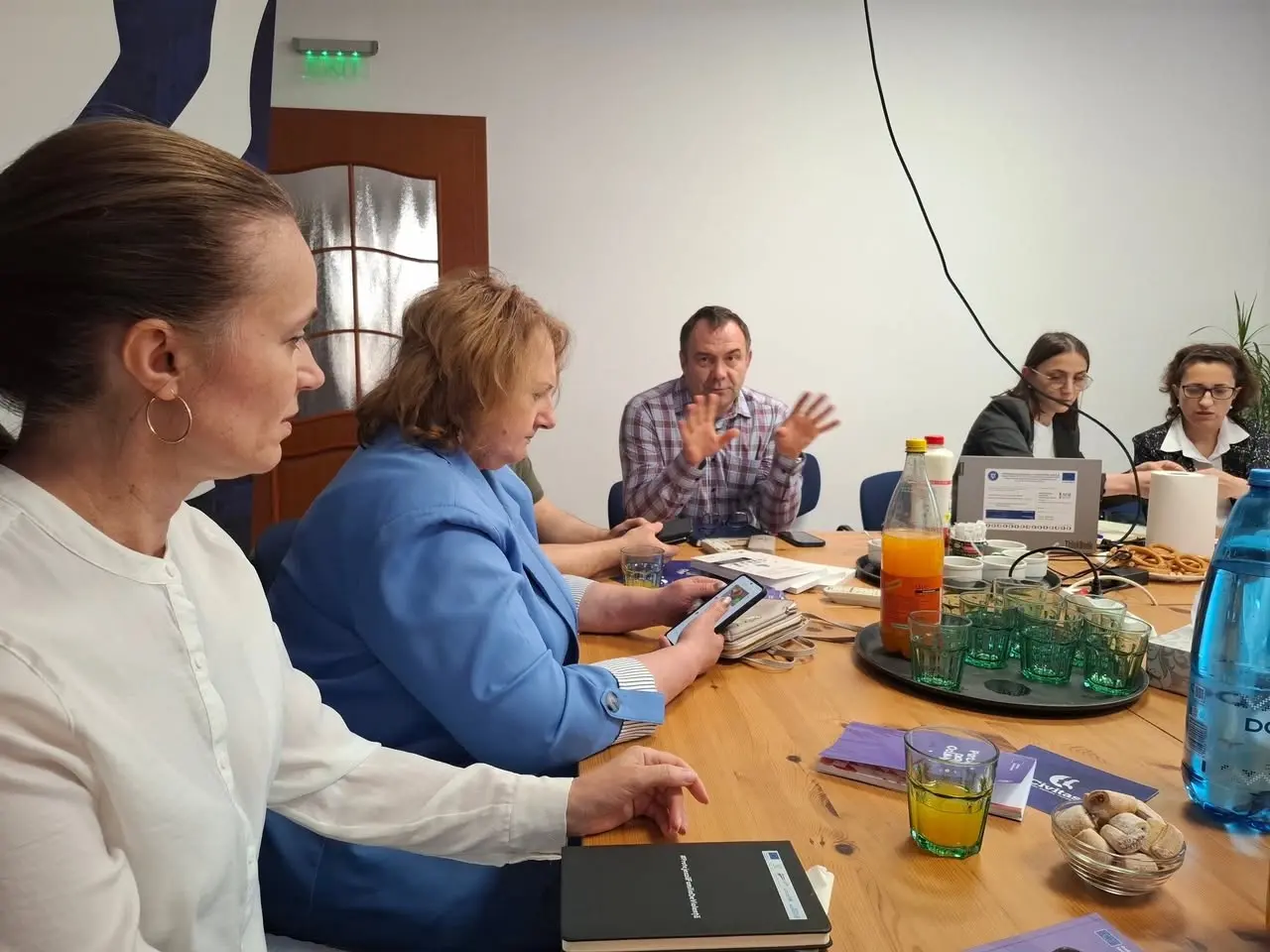
Update, 19 June. On the second day, 18 June, the delegation visited the Căianu and Mociu town halls and the Cluj-Napoca city hall, where the talks focused on local development through the LEADER approach and the management of social projects. The „Câmpia Transilvaniei” Local Action Group showed them how a LAG works — the mechanism by which several rural communities join forces to draw European funds and carry out projects together, exactly the kind of inter-community cooperation Ungheni district is moving toward through its town-hall reform.
A delegation from Ungheni district is in Cluj-Napoca these days on a study visit about dialogue with citizens and about cooperation between town halls and civic organisations. The visit was organised and announced by the “Inovații Sociale” public association, which coordinates the delegation, and the first day of the programme took place at the Civitas Foundation — a Cluj organisation with nearly three decades of experience in community development and good governance.
On paper, it is a technical activity, easy to overlook. In reality, it lands at the most sensitive moment for local government in the district: right now, until 29 June, the people of Ungheni are being consulted on whether the town of Ungheni should merge with nine surrounding localities, and “genuine consultation of citizens” is precisely the point around which the amalgamation dispute turns. In other words, people from Ungheni are going to see how dialogue with citizens is done in Europe just as, back home, that dialogue is being put to the test.
What the visit actually is
According to the organiser, the delegation is taking part on 17 and 18 June in a programme in Cluj-Napoca dedicated to “strengthening civic dialogue and promoting good practice in community development.” The stated aim is to exchange experience and identify European solutions that can be adapted in the district’s communities. Exactly who is in the delegation — mayors, councillors, representatives of local organisations — has not been stated publicly.
The host of the first day, the Civitas Foundation, has worked since 1992 along four lines: community development and good governance, social economy and entrepreneurship, civil society empowerment, and rural development. It is the kind of organisation from which small administrations usually borrow concrete mechanisms — from participatory budgeting to the way a town hall consults its residents before an important decision.
The money and the programme behind it
The visit is funded by the European Union, under a programme that appears in the organisers’ communication as “INSPIRA Moldova.” It is the same programme that the funder and its partners officially call “INSPIRED Moldova” (or “INSPIRĂ Moldova” in the Romanian version). The programme is coordinated by the European Partnership for Democracy, runs from September 2024 to February 2027 and provides technical and financial support to 70 civil society organisations in Moldova, with the aim of strengthening democratic decision-making at local level.
One component of this effort bears directly on the relationship between citizens and town halls. Under the programme, 32 organisations in Moldova received grants worth a total of 622,000 EUR to set up and run local consultation platforms — that is, mechanisms through which people can be asked, in an organised way, before the authorities decide. Triunghi.md could not establish from public sources whether “Inovații Sociale” is among these 32 organisations or what the exact amount of the grant covering the Cluj visit is; the named list of beneficiaries is not published in the European statement.
Why it matters for Ungheni
The link with home is not theoretical. Ungheni district is going through the largest reform of its town halls in years, built around a threshold of 3,000 inhabitants below which a town hall is no longer considered viable — and 23 of the district’s 33 town halls are below that line. Against this backdrop, the town of Ungheni opened a voluntary merger with nine localities, a future town of around 44,000 people, with public consultation ending on 29 June.
The whole process stands or falls on how exactly people are asked. In Măcărești, for instance, a village assembly voted in favour of the merger, and then the decision was challenged and a new council vote was demanded — exactly the kind of procedural tension that “good practice in civic dialogue” promises to prevent. Cooperation between communities is not new in the district either: in April 2025, 23 localities in the area set up an inter-community development association with the support of another European programme.
For now, the Cluj visit remains an announcement by the organiser, with no concrete result on the table. Its real value will show in what those who travelled bring home: whether a consultation mechanism learned in Transylvania ends up being used at a town-hall meeting in Ungheni district, or whether it remains a group photo and a set of good intentions. For a district that is right now rewriting its administrative map, the difference is not a small one.