

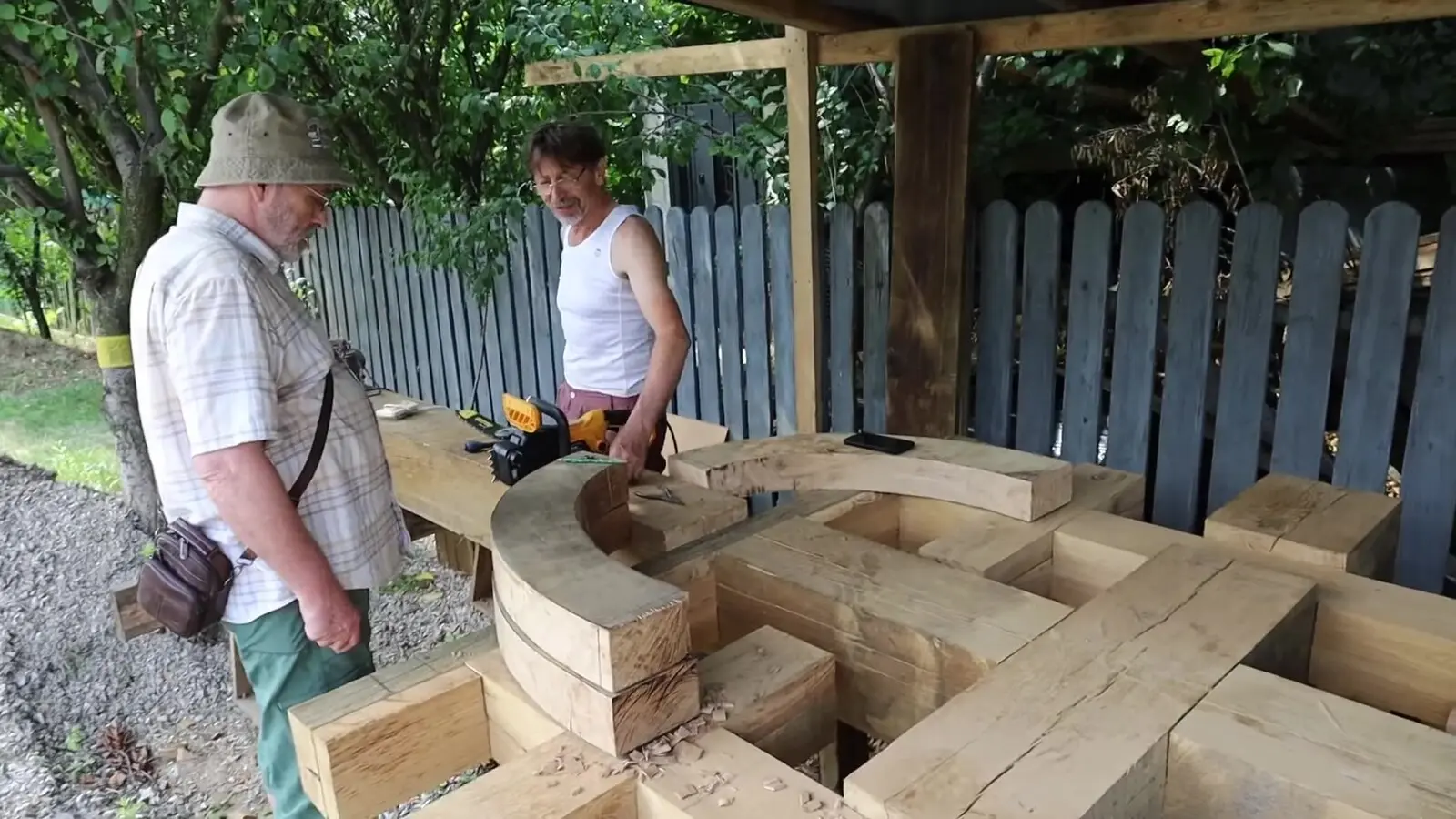
In a yard with a shed and a blue fence, on the edge of the village, two craftsmen bend over a heap of oak beams. Out of them, slowly, a large cross takes shape — a troiță, a wayside memorial cross. In Valea Mare, a commune in the Ungheni district, the villagers are raising a monument of memory: the “Troița of Memory and Gratitude” (Troița Memoriei și Recunoștinței), dedicated to those who fought in the two world wars and to those deported in 1941 and 1949.
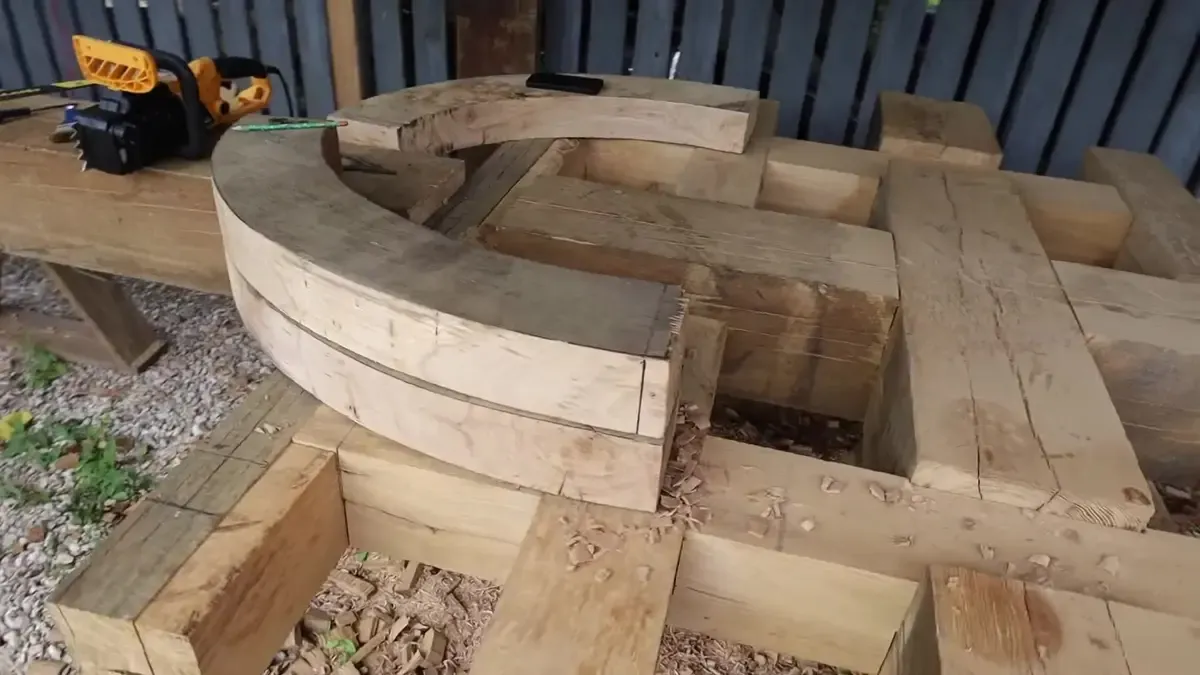
The oak beams, joined by hand, in the yard where the troiță is being built. Video still: Vasile Iucal / Facebook.
The work — filmed and made public on 6 July by Vasile Iucal, director of the Ungheni Museum of History and Ethnography — is still in progress. But the paperwork behind it is already almost two years old.
What the town hall’s act says
The monument is no spur-of-the-moment idea. On 18 October 2024, the Valea Mare Communal Council unanimously — 12 votes in favour — adopted a decision “on initiating the procedure to erect the public monument of a religious character — the «Troița»”, in the square in front of the town hall. The act, in force and published in the State Register of Local Acts, stems from a petition by a “group of citizens” in the commune and sets one essential point: the design and construction costs are borne by the town hall budget. As it is a public monument, Mayor Alexei Antoci was also authorised to obtain the approval of the Ministry of Culture, which the law makes mandatory.
Between the 2024 document and the 2026 work, the concept appears to have broadened. The council’s decision spoke only of “the heroes of World War II”. The town hall’s current announcement and the dedication on the ground take in more: the First World War as well, and the deportees of 1941 and 1949, under the full name “Troița of Memory and Gratitude”.
A dedication with local roots
The choice is not rhetorical. The village of Valea Mare has its own names in the “Book of Memory”, the official catalogue of the victims of totalitarianism. Among the families taken away in 1941 is that of Vartolomei Stoica — a mill owner deported with his relatives to the Tomsk region — and the Ureche family, whose head was arrested in 1941 and died in detention, while the rest were sent to the Tyumen region. Across the whole Ungheni district, the catalogue gathers around 2,900 names from more than 60 localities.
On a village scale, Valea Mare is following a pattern already familiar in the district: in the town of Ungheni, the 6 July commemorations are held year after year at the Troița of the Nation’s Martyrs, a wooden monument raised in memory of the victims of the repressions. Now a village is making its own place of memory.
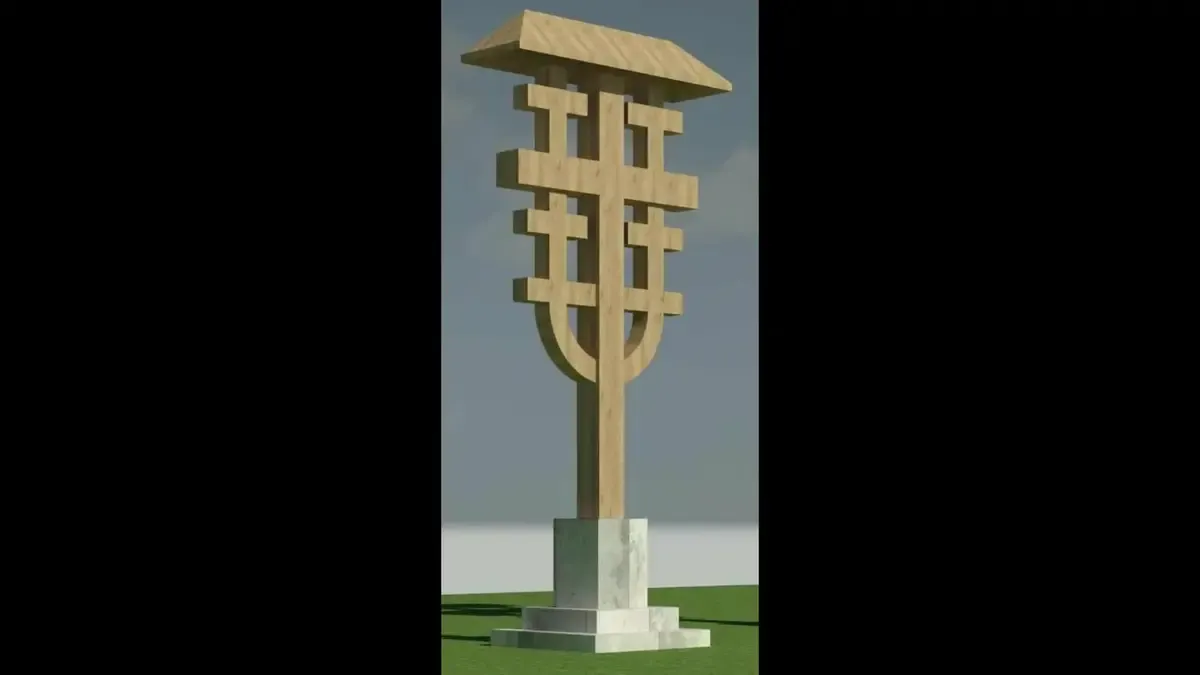
This is how the finished troiță is expected to look, according to the model shown in the footage.
For now, a few details remain with the town hall. The 2024 act places the cost on the local budget without fixing a sum, and the administration has not publicly stated how much the monument costs or when it will be finished. For a public monument, the law also requires the Ministry of Culture’s approval — a step not publicly confirmed so far. In the meantime, the Valea Mare troiță keeps rising from oak beams, from the village’s money and the work of its craftsmen.