
Ungheni Raion Council signed the cooperation memorandum with the LEEN Moldova programme on 30 July, on the basis of decision no. 4/9 of 18 June. The figure against which any energy saving is measured sits in the public procurement data: what the energy of the raion’s public institutions costs.
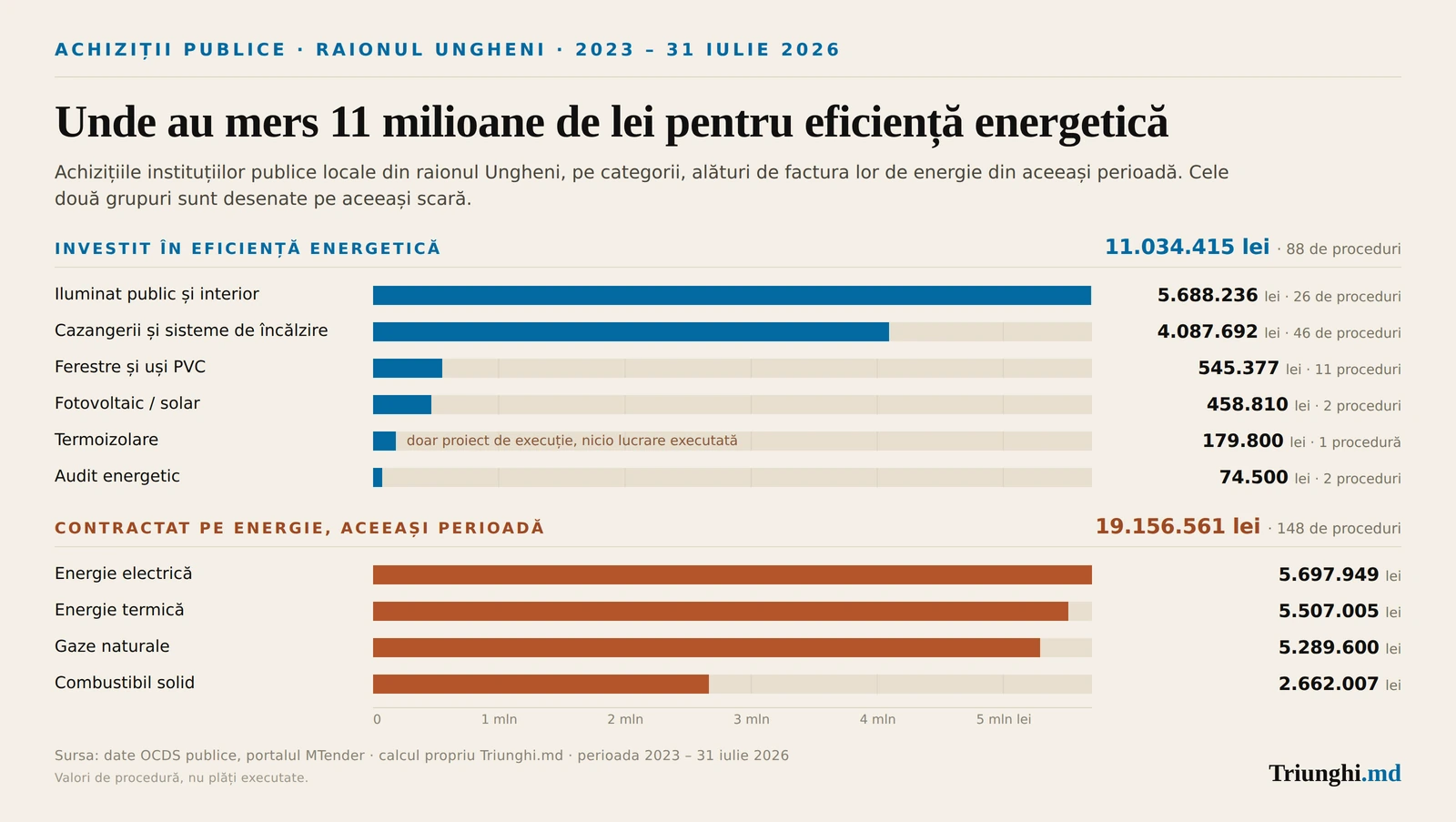
From the OCDS data published by the MTender portal, between 1 January 2023 and 31 July 2026 the raion’s town halls, lyceums and gymnasiums contracted energy worth 19,156,561 lei, across 148 procedures; with the state’s deconcentrated services added in, 25,733,118 lei. The bill splits almost evenly between electricity (5,697,949 lei), heat (5,507,005) and natural gas (5,289,600), plus 2,662,007 on solid fuel — firewood, coal and briquettes, since pellets and heavy fuel oil do not appear in the raion at all.
The Raion Council does not itself appear as a buyer of energy: its own 201 procedures contain no gas, electricity or heat — only motor fuel — with the institutions under its authority buying on their own account. The programme is implemented by the Alliance for Energy Efficiency and Renewables (AEER), with the support of the E4M project — financed by the German ministry for economic cooperation (BMZ) and implemented by GIZ Moldova. That is why the decision names AEER, while the Facebook announcement names GIZ.
Where the efficiency money has gone so far
Before the memorandum, public institutions in the raion had contracted energy-efficiency works worth 11,034,415 lei, across 88 procedures. More than half — 5,688,236 lei — went into public and indoor lighting, and 4,087,692 into boiler houses. Thermal insulation appears just once, at 179,800 lei, and not as works but as a detailed design commissioned by the Education Directorate.
Public lighting and boiler houses are not wrong investments: a new boiler burns less gas for the same heat, an LED fitting draws less current for the same street. The money went, however, into producing light and heat more cheaply, and almost none of it into not losing them. The finding is about the structure of the expenditure, not about its quality. The seven roof repairs, worth 2,446,184 lei, are not declared as thermal works and were not counted here. One of the two photovoltaic procurements belongs to the Raion Council itself — 54,470 lei for solar street lighting.
That does not mean no thermal insulation is being done in the raion. At the Costuleni gymnasium, works worth more than 2.4 million lei came from the national “European Village” programme, through the National Fund for Regional and Local Development — money that does not pass through the procurements of the raion’s institutions. Costuleni also figures as an example in the LEEN network, but belonging to the network is not the source of that money.
The audit, the first step of the method
The stages published by AEER run from identifying the beneficiaries and the energy managers, through forming the network and running courses, to implementing measures and reporting. The audit does not figure as an obligation, although it remains the standard instrument that says, in figures, which wall the heat is escaping through. Two institutions contracted one, 74,500 lei in total: Buciumeni Town Hall (25,000) and the Education Directorate (49,500). In October 2025 the programme also awarded an audit voucher to each of the active town halls.
The method the programme takes its name from looks different: the German LEEN networks bring together 8–15 firms with energy costs of more than 500,000 euros a year, with a mandatory audit on entry, a common target and annual monitoring. The Moldovan version addresses town halls and raion councils, with no threshold, no mandatory audit and no quantified targets. The results of the German networks do not transfer onto the network in Moldova.
What the memorandum obliges and what it costs
Read in full, the memorandum provides for no membership fee and no payment falling on the local authority; the training is free of charge, including the certification course for energy managers, covered in full by the programme. The only obligation with a potential cost appears in the raion’s own decision, at point 3 — contributing to the delegation, employment or contracting of an energy manager. No sum is written either there or in the memorandum.
The cost can also be zero. Ungheni City Hall met the same obligation by designating an existing employee: Ghenadie Ciobanu, chief specialist, has been local energy manager since 25 July 2025.
The coordinator of the LEEN initiative, Marco Buechel, has pointed out that employing an energy manager at each authority separately is often costly and that one of the solutions proposed is sharing a specialist through inter-community cooperation; the programme’s page states that “every locality or group of localities” will have a manager. And at the LEEN training session the secretary of the Raion Council, Liliana Tincu, presented the experience of the «Ungheni» Inter-Community Development Association — precisely the mechanism the programme indicates as the way to meet this obligation.
Four deadlines for the same commitment
Article 4 of the memorandum sets a horizon that is already close:
The local public authorities undertake to take part in the project at least until its completion in September 2026.
LEEN cooperation memorandum — Ungheni Raion Council, article 4
The signature was put down on 30 July 2026, less than two months before that deadline. Article 5, however, says that the memorandum “is concluded for a period of four years from the date of entry into force”, the AEER project page gives 11/2026, and the E4M umbrella project runs until 31 October 2027.
The “September 2026” clause is not a scanning error: it appears identically, in Romanian and in Russian, in Costuleni Local Council decision no. 07/10 of December 2024. The most likely explanation is prosaic — a template memorandum, signed unchanged close to the end of a project cycle, with the cooperation carried further by the four-year clause. Which of them governs is a question put to both signatories.
Joining is not a distinction. Publishing the document is
LEEN Moldova was launched on 26 September 2024. The State Register of Local Acts holds at least 58 accession acts, from more than 20 raions, and by the count of those acts Ungheni Raion Council is at least the sixth raion council in the country to sign. Within the raion, three town halls had gone in before it: Costuleni on 10 December 2024, Ungheni municipality on 20 December 2024 and Măcărești on 17 November 2025.
Of the four authorities, only two also published the text of the memorandum, as an annex to the decision: Costuleni, in December 2024, and the Raion Council, in June 2026. On the decisions of Ungheni municipality and of Măcărești, published in the same register, the annex does not appear. Without those two annexes, neither the deadlines nor the obligations above would have been verifiable from outside.
The energy and climate plan, where the next money sits
Law 113/2023, which amended Law 139/2018 on energy efficiency, set a deadline: the first local integrated energy and climate plan was to be approved by raion councils by 30 June 2025, for the 2025–2030 period. The stake is not a shelf one: having the plan and reporting the measures are conditions of eligibility for financing energy-efficiency projects out of public money or from development partners — including for the town halls in that raion.
No such plan figures among Ungheni Raion Council’s acts in the register, searched both with and without diacritics. Absence from a register does not prove that the document does not exist — publication can run late, and an act can be registered under another title; this question was put directly to the Raion Council. Verifiable in the same register: Sculeni Town Hall, which was not obliged by law, approved “The integrated energy and climate plan of Sculeni commune for the 2026–2030 period”, by decision 04/02 of 29 June 2026.
What the programme has produced, measurably
Almost two years on from the launch, not a single saving figure achieved by LEEN Moldova has been published — no kilowatt-hours, no lei, no percentages, on any building. At the network’s fourth session, on 16 October 2025, the E4M project manager closed the proceedings like this:
We are looking forward to moving out of the planning and data-collection phase and to taking tangible steps towards establishing the position of energy manager at local public authority level.
Torsten Greis, E4M project manager, at the fourth LEEN Moldova working session, 16 October 2025
How the figures were obtained
The sums come from a complete pass through the 9,527 procedures published by buyers in Ungheni raion on MTender within this window; the figure cited is the procurement value, not the budget line. The limits belong to the system, not to the raion: estimated does not mean awarded, and awarded does not mean executed — actual payments, contract amendments and below-threshold purchases are not found in MTender. Only 39 of the raion’s 93 buyers have any energy procurement recorded, and large institutions are missing: the Raion Dental Centre, the «Mihai Eminescu» Theoretical Lyceum and the Vocational School. The Raion Hospital appears with 77,541 lei over three years, almost entirely works — its energy bill is nowhere to be seen. The year 2026 is partial and under-reported, and fourteen procedures have values obviously mis-entered at source. The real bill therefore lies between 25.7 and 28.3 million lei.
Questions were put to Ungheni Raion Council under Law 148/2023 on access to information — about the designated energy manager, the cost of joining, the buildings targeted and the energy and climate plan — with a reply deadline of 12 August; AEER received a set of questions with a deadline of 7 August.
Update: what the Council answered (12 August 2026)
Ungheni Raion Council replied to the request within the statutory deadline — letter no. T-37/33 of 12 August, signed by the raion president, Dionisie Ternovschi. The reply confirms in writing what the documents already indicated, and adds a few clarifications.
Energy manager — not yet. The Council says that “at this stage” it has not designated an energy manager within the institution and that, depending on needs and resources, it may later contract specialised external services. Ungheni municipality had already met the same obligation by designating an existing employee.
Cost — zero to join. Joining entails no cost to the raion budget, with no membership fee and no co-financing — exactly what the memorandum provides. Any later contracting of services would be assessed separately.
Buildings targeted. Public institutions under the Council’s authority, especially those with significant energy consumption in education, health and administration; concrete prioritisation is to be based on consumption data and specialist assessments. A quantitative reduction target has not yet been set.
The energy and climate plan — confirmed: not approved. The Council states that it has not approved a local integrated energy and climate plan — the document the law required by 30 June 2025 and on which eligibility for funding depends. Its drafting, the Council says, will be supported by the “Energy Management in Region 5 (Ungheni, Călărași, Nisporeni)” project, currently under way.
AEER, which had received a set of questions with a 7 August deadline, had not replied by the time this update was published.