

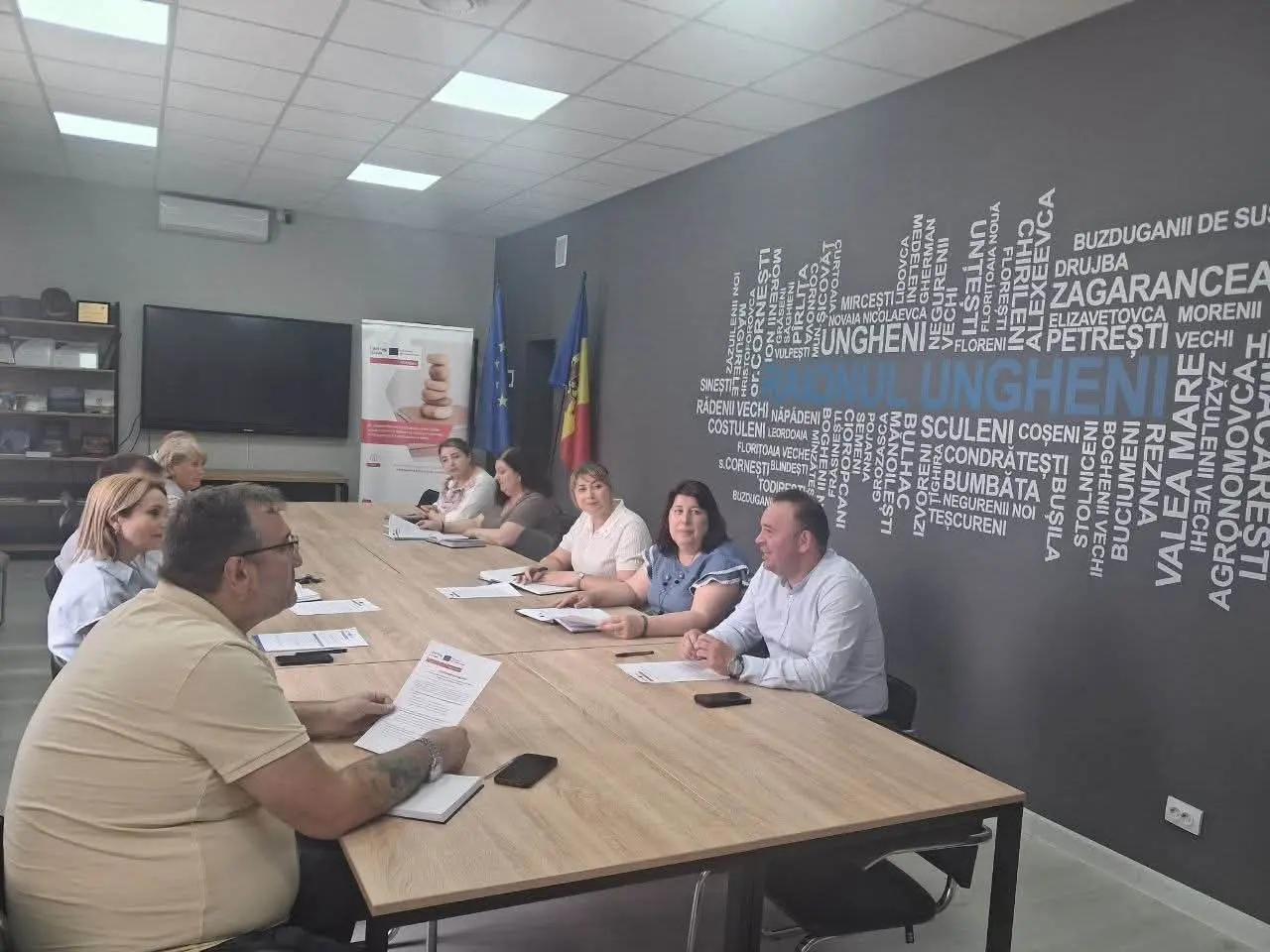
Employers in Ungheni District — in agriculture, manufacturing and services — have confirmed their readiness to hire workers from outside the European Union, and the District Council is looking for ways to open a Migrant Integration Centre. These are the two substantive announcements in the statement published on Wednesday, 22 July, after the meeting between the implementation team of the European MILEstone project and the district’s institutions and business community.
According to the statement, the meeting brought together the district leadership and representatives of deconcentrated state services, the business community and the education, social and cultural sectors. The president of Ungheni District, Dionisie Ternovschi, opened the meeting by speaking about the opportunity the project represents in the context of the growing flow of migrants in the Republic of Moldova and at the local level, and about aligning public policies with European standards for labour market integration.
Participants examined the flow of foreign workers arriving from outside the EU — the statement gives India and Nepal as examples — through specialised companies. Beyond the assessments, the meeting also listed what is missing: tools for monitoring migration flows, free retraining and Romanian language courses and, above all, a clear concept — with money and structure — for the future integration centre.
The guide for foreign workers, not yet published
The meeting also included a technical consultation on the “Digital Guide for the foreign worker and citizen in Ungheni District” — a document gathering information on legal status, labour rights, access to healthcare, education, banking services and integration into the community. According to the statement, the guide will be translated into English and published on the District Council’s official website. As of the date of this article, the guide appears neither on the council’s website nor in the project’s public library — Wednesday’s statement is its first public mention.
Why Ungheni is looking for workers in Asia
The answer lies in the data series of the National Bureau of Statistics (BNS), and the newsroom’s calculations on those series show the scale of the gap.
On 1 January 2014, Ungheni District had 96.471 inhabitants with usual residence. On 1 January 2026 — 73.971 (preliminary data). Minus 22.500 people, or nearly a quarter (23,3%) of the population, in 12 years.
And the structure of the loss is worse than the total. The working-age group, 15–64, shrank by a third: from 68.153 to 45.899 people. Young people aged 20–34 — precisely the pool from which agriculture and manufacturing recruit — dwindled from 23.372 to 9.720, a drop of 58%. Meanwhile, the number of people over 65 grew by 36%, and births halved: 732 children born in 2025, compared with 1.481 in 2011.
Who is leaving and who is dying? The arithmetic is unequivocal: over the period 2014–2025, 14.434 people were born in the district and 14.378 died — a natural balance of just plus 56 people. Virtually the entire population decline comes from departures, not from mortality.
Nor is there an internal labour reserve to draw on: the unemployment rate in the Centre statistical region stood at just 3% in 2025, with an employment rate of 34,4% — few unemployed, but also few economically active people. And the district’s average gross salary, 11.321 lei in 2024, remains at 81% of the national average — one more reason why those who left are in no hurry to come back.
Nepal, the new leader of labour migration to Moldova
What Ungheni is announcing is already happening across the country. The number of immigrants arriving in Moldova for work tripled in five years: from 1.305 in 2020 to 4.063 in 2025, according to BNS data based on the records of the General Inspectorate for Migration (IGM). Last year, work was again the main reason for immigration — for the first time, more than half of the total (58%).
And the map of countries of origin has been redrawn. In 2025, Nepal climbed to first place, with 698 workers — overtaking Turkey, the traditional leader. Next come Uzbekistan with 669, India with 379 (double the 2024 figure) and Bangladesh with 317 (almost five times more than in 2024). With India, Moldova signed a declaration of intent for a migration and mobility partnership in December 2024, in New Delhi.
What the phenomenon looks like on the ground can be seen in neighbouring districts: in mid-July, the IGM held information sessions for around 150 Nepalese citizens employed at a cable plant in the Free Economic Zone Orhei and for another 103 foreign workers at a brick plant in Anenii Noi.
The rules of the game are changing too: on 30 April 2026, Parliament adopted a new law on the admission and stay of foreigners, which enters into force on 1 June 2027. It introduces 23 residence purposes, the single “Residence Card” document, online submission of applications and the obligation for a foreign worker to be paid at least as much as a local employee in a similar position.
Ungheni starts almost from scratch
In the district itself, the ground is so far unprepared — the MILEstone project’s own baseline study, published in September 2025, says as much. Ungheni District has no one-stop integration centre offering registration, counselling, language courses or legal support, the document finds. Migrants who arrive here are counted, statistically, in Chișinău — where they are registered — so no public record of the district’s foreign workers exists.
Hiring, however, has begun. The same study notes that employers in the Free Economic Zone Ungheni, such as Lear Corporation and EuroYarns, have already hired migrants and have the capacity to offer jobs.
The Republic of Moldova currently has three integration centres for foreigners, opened in 2017 in Chișinău, Bălți and Cahul — all in municipalities, run by the IGM. A district-level centre does not appear in the publicly available information: if the Ungheni plan goes ahead, it would be the first of its kind.
The project behind the plan
The institutional framework for these preparations is project 01C0070 MILEstone — “Integration of migrants in local economies”, funded by the European Union through the Interreg Europe programme: a consortium of 12 partners from 11 countries, led by the German district of Burgenlandkreis, with an implementation period running from 1 March 2023 to 31 May 2027. Ungheni District Council joined as a full partner in 2024 — the only one from Moldova — with its own budget of 75.480 euros, of which the district’s contribution is 15.096 euros.
The decisive legal step was taken in December 2025: through Decision 8/7 of 9 December, the council added a package of measures for migrants to the district’s Socio-Economic Development Strategy 2022–2030 — the development of a one-stop integration centre, entrepreneurial support, expanded Romanian language courses, the recognition of qualifications. Wednesday’s meeting assessed precisely this instrument, about seven months after its approval, and the European programme records it as one of the policies improved by the project.
Two things, however, remain unfixed in the public documents. The integration centre has, for now, no budget, no deadline and no location — the annex to the decision assigns it to external funding, the Government and external donors. And there is no public figure for the foreign workers already employed in Ungheni District — the records, kept centrally by the IGM, are not published at this level.