

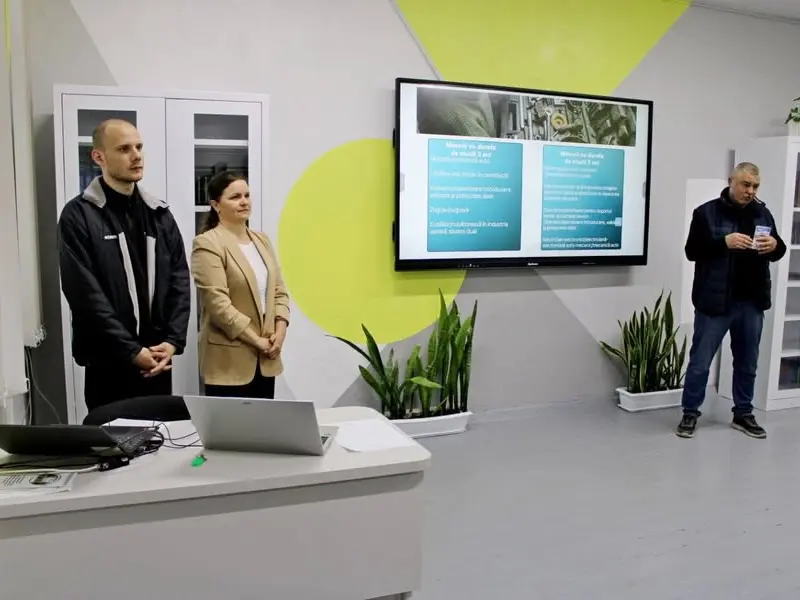
From March to May, the teachers of the only vocational school in Ungheni district knocked, one by one, on the doors of the lower-secondary schools. They stood in front of pupils from gymnasiums in four districts — Ungheni, Fălești, Călărași and Nisporeni — with leaflets, a presentation and a simple question: after the ninth grade, what comes next? The campaign, which the school called the “Trades Caravan 2026”, ended last month, and the institution made its results public on 19 June.
At first glance, it is an ordinary recruitment drive ahead of the admissions season. Read against the district’s figures, though, it says something less ordinary: in an Ungheni that loses people year after year, vocational education is not fading — on the contrary, it is drawing in more and more young people.
What a lower-secondary graduate can study at home
The Ungheni Vocational School is, according to official statistics, the only institution of its kind in the district. That means that, for a pupil who wants a trade without leaving the area, this is, in practice, the only local door.
The offer covers the fields the school claims for itself: energy, engineering, light industry, construction and telecommunications. Specifically, the institution’s website lists trades such as technical-support and data operator, electrical fitter and electrician-locksmith, car electrician-electronics technician with a driving licence, electric-and-gas welder (welder-fitter), electrician-fitter in construction, car mechanic, house painter and sewer in the garment industry. The programmes last two or three years, depending on the trade.
One of them — sewer, in the garment industry — is organised in dual form: the pupil studies partly at the school and partly directly with an employer, under a contract and, as a rule, with pay for the practical hours. For Ungheni, where light industry has a tradition, it is a natural match between what local factories produce and what the school trains for.
How to enrol
Admission to vocational and technical education is done online, through the national e-Admitere (SIME) platform. The file requires the enrolment form, a copy of the ID card, the study certificate, a photo and proof of the registration fee, according to the Ministry of Education and Research, which amended the admission regulation for the 2026–2027 academic year.
One detail remains, for now, outside the public documents: the school’s admission plan for 2026 — that is, the exact number of places per trade, with and without fees. At the time of publication, the dedicated pages on the school’s website were still empty. The figure is usually published when the admissions season opens.
The figures: vocational education is rebounding
For many years, the “vocational school” was, in public perception, the second choice. Today’s statistics say otherwise.
Nationwide, the number of students in secondary vocational and technical education rose from 14,357 in the 2022/2023 school year to 15,649 in 2025/2026. And the number enrolled in the first year — those who have just chosen this path — grew from 6,798 to 8,155, a fifth more in just three years. At the same time, the network shrank to 34 institutions through mergers: fewer schools, but more students in them.
The trend shows in Ungheni too. The school’s student body rose from 413 in 2022/2023 to a peak of 560 in 2024/2025, before settling at 538 this academic year — nearly a third above the level of three years ago. And the class that finished in 2025 numbered 212 graduates, against 121 a year earlier.
Why it matters for Ungheni
This is where the contrast that gives the story its weight comes in. According to the National Bureau of Statistics, the population of Ungheni district fell from 96,292 residents in 2014 to 74,507 in 2025 (preliminary data) — almost 22,000 fewer people in 11 years. The district is ageing and emptying out, and young people are precisely the group that leaves first, after high school or after lower-secondary school.
Against this backdrop, a school that keeps and trains young people in the district is no longer an administrative detail. The trades it teaches — electrician, welder, car mechanic, garment worker — are among the most sought after on a labour market where the shortage of skilled workers is a chronic problem. In other words, for a lower-secondary graduate from the district, a trade learned at home can mean a job at home too — and one more reason to stay.
The money and the modernisation come from abroad too
The recovery of vocational education is not happening on its own. The dual component, which includes the sewer trade in Ungheni, is part of a national effort backed from outside: in 2025/2026, about 3,300 students in the country are learning in dual form, across 45 institutions and in partnership with some 230 companies. The programme is supported, through the German cooperation agency GIZ, by Germany’s Ministry for Economic Cooperation and the Swiss government, under the project “Strong Enterprises and Communities for Moldova”.
In terms of places on offer, vocational and technical education made available, for 2025–2026, 12,297 state-funded places, 8,171 fee-paying and 2,134 in dual form.
The trades offer, the dual programme and the figures above all come from official sources, and their conclusion points in a single direction. For a family in Ungheni asking their child “what will you do after the ninth grade?”, the answer “a trade, here” carries more weight today than it did three years ago.
The figures on vocational and technical education — nationwide and for Ungheni district — and the demographic data belong to the National Bureau of Statistics (2025 data; population figures are preliminary). The trades offer and the dual programme come from the website of the Ungheni Vocational School; the admission framework and conditions, from the Ministry of Education and Research. The “Trades Caravan” is not a single national programme under that name — the label is used by several vocational schools for their own career-guidance campaigns; in this case, it is a campaign by the Ungheni Vocational School. How many pupils and how many gymnasiums the caravan actually reached this year, and the 2026 admission plan broken down by trade, were not public at the time of writing.