
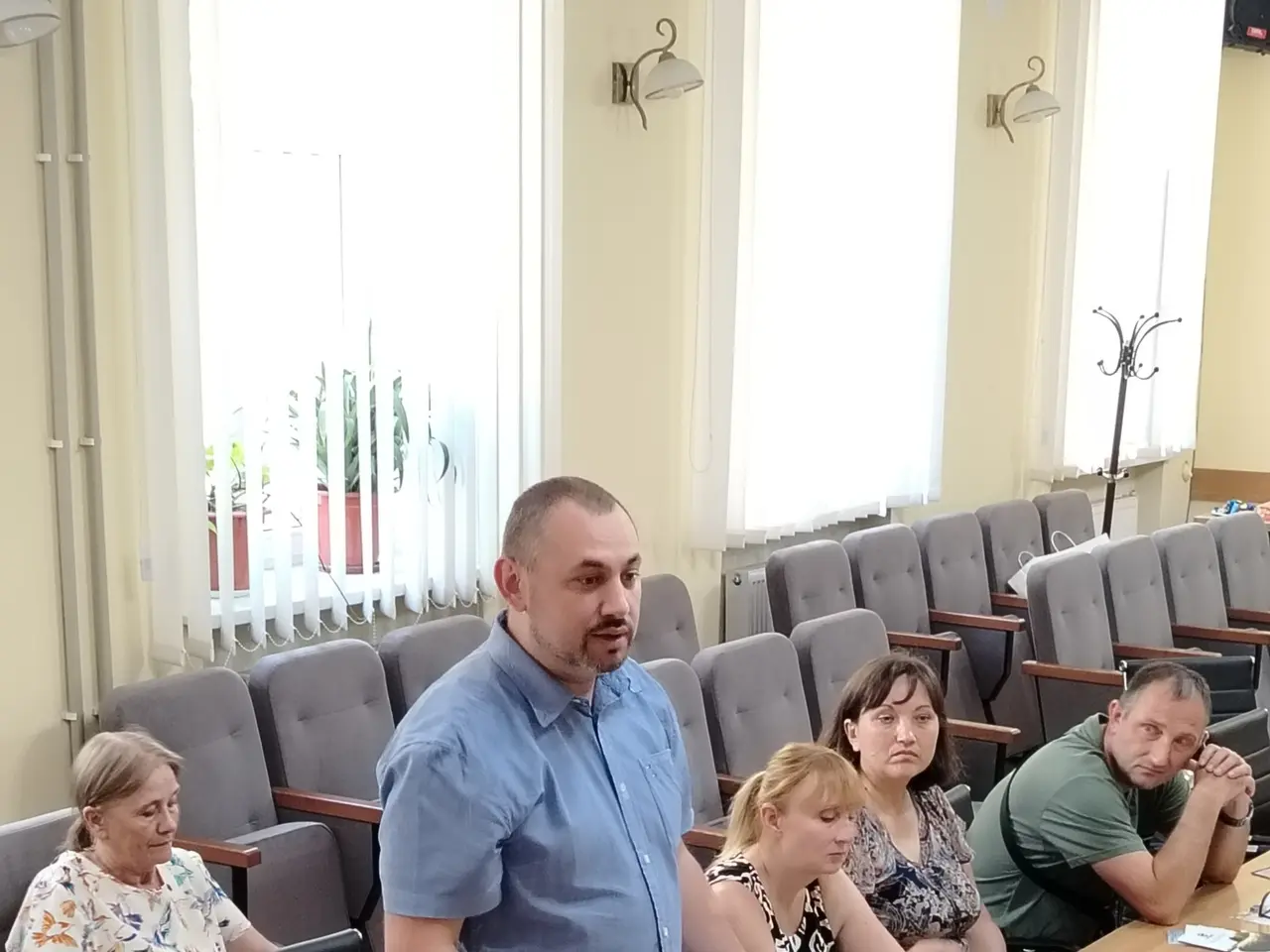
The town of Ungheni takes its tap water from a single place: the Prut River. That is precisely why a piece of news that elsewhere would go unnoticed — a project counting the bits of plastic in a river’s water — has a direct stake here. On 25 June, the teams of a Romania–Moldova cross-border project called PLASTICWISE met at the Ungheni District Council and then went down to the bank of the Prut, by «Micul Cluj» Park, to discuss the microplastics in the river and their effects on nature and health.
What PLASTICWISE is
PLASTICWISE is a small project, funded by the European Union through the Interreg VI-A NEXT Romania–Republic of Moldova cross-border cooperation programme. It is coordinated by an organisation from Iași — Asociația pentru Ecologie și Dezvoltare Durabilă — together with a partner from Moldova, the Society of Ecotoxicologists (ECOTOX), with the scientific lead held by the researcher Elena Zubcov, of the Institute of Zoology. The project began in July 2025 and runs until mid-January 2027 — eighteen months.
Its idea is simple to state and hard to do: to set up a system for monitoring the Prut’s plastic pollution where none existed before. In practice, the researchers take an inventory of the river’s fish, analyse their stomach contents to see how much microplastic they swallow, and examine the particles in the water. Beyond the scientific part, the project is building a joint strategy and an eco-tourism campaign on the Prut. As a small project, its budget falls, under the call’s rules, within the ceiling of up to 300,000 euros, with 90% European funding — the exact figure, however, is not published.
Why it matters precisely here
The answer is in the pipe. Unlike localities that use water from wells or boreholes, the town of Ungheni is supplied directly from the Prut, through an intake built in 1972 and rebuilt in 2004, with a capacity of 12,700 cubic metres a day. More than 40,800 people — from the town and neighbouring villages — depend on the treated water from the Prut. And the operator, Apă-Canal Ungheni, itself acknowledges that pollution of the source is rising; the treatment plant has, for that matter, also entered a modernisation process.
In other words, what happens to the quality of the Prut’s water is not an abstract environmental matter, but what flows, after treatment, from Ungheni taps.
What is — and isn’t — known about plastic in the river
Honesty is needed here. PLASTICWISE has not yet published any measurement results — how much microplastic the Prut’s water holds, at which points, in what concentrations. The study is under way, and the data are to be made public later. Until then, any figure would be an invention.
What is known, from outside the project, is that the Prut has long had a pollution problem. A study published in 2018 in an international scientific journal identified, on the Sculeni–Brânza stretch, 88 micropollutants in the river’s water, with a load of about 19 kilograms a day at Brânza, coming largely from insufficiently treated wastewater from the Iași area. That study, however, did not look for microplastics — exactly the gap PLASTICWISE now wants to fill.
How dangerous microplastics in drinking water are is, in turn, a question without a definitive answer. The World Health Organization, which examined the subject in 2019 and again in 2022, says the evidence so far is limited and does not show a clear health risk from microplastics in drinking water; larger particles are probably not absorbed by the body, and data on the nano-sized ones are insufficient. The WHO nevertheless recommends reducing exposure and pollution — which is exactly the direction in which a project like PLASTICWISE works.
Who sat at the table, in Ungheni
A point of precision, so as not to inflate things. The workshop at the Ungheni District Council was a working meeting of the project’s partners — the ones from Iași and the ones from Chișinău — who presented the state of the activities and the next steps; PLASTICWISE officially has only these two partners. The voice of the water operator and of the district’s environmental authorities on what microplastics practically mean for tap water remains to be gathered — and that is the next question we have to ask.
For now, what we have is a project that came to measure, on a river an entire town drinks from, something no one had measured systematically before. The figures will come; what matters is that, at last, someone is looking for them.
The data on the PLASTICWISE project — name, code, partners, duration, objectives — come from the project’s coordinator, Asociația pentru Ecologie și Dezvoltare Durabilă of Iași, and from the Moldovan partner, ECOTOX; the exact budget is not published, the range given being that of the funding call’s rules. The details of the 25 June workshop come from ECOTOX’s announcement. The data on Ungheni’s drinking-water abstraction from the Prut come from the operator Apă-Canal Ungheni; the figure of more than 40,800 beneficiaries, from an own article. The 2018 study on the Prut’s micropollutants is published in «Environmental Science and Pollution Research». The assessments of the health risk of microplastics are those of the World Health Organization (2019, 2022) and are reported as such. PLASTICWISE had not, at the time of writing, published any results of microplastic measurements in the Prut. Triunghi.md had not, by the time of publication, obtained a reaction from the operator Apă-Canal Ungheni or from environmental authorities on microplastics in the water source.