

Update, 7 July 2026. Subsequently, despite this local position, ANRE did approve a tariff increase — water and sewerage in Ungheni rise to 40.01 lei/m³. See the new article. The text below reflects the situation as of 26 June 2026.
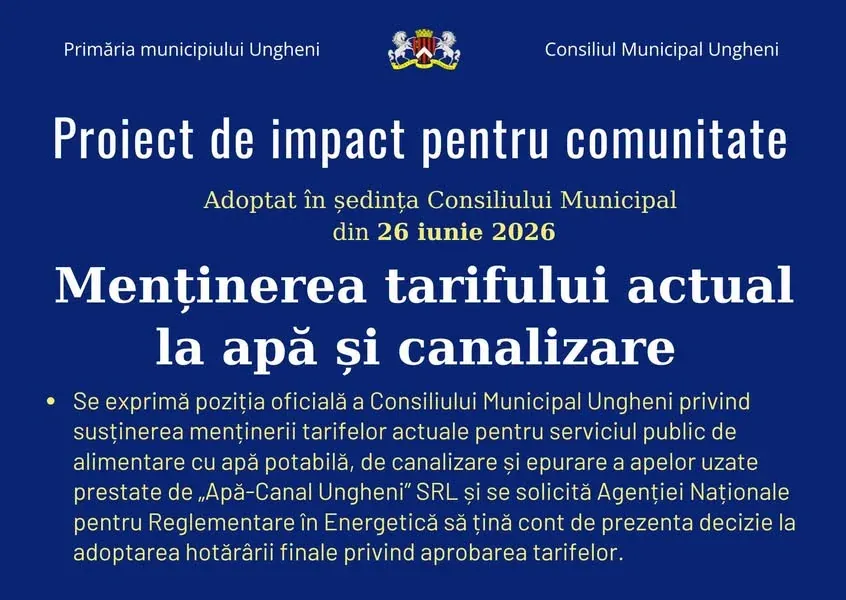
On 26 June, the Ungheni Municipal Council adopted an official position supporting the maintenance, at the current level, of tariffs for drinking water, sewerage and wastewater treatment charged by “Apă-Canal Ungheni” SRL. In concrete terms, the price stays at 38.25 lei per cubic metre of water and sewerage — 23.54 lei for water and 14.71 lei for sewerage — the same as before.
The decision does not, however, freeze the tariffs on its own. The price of water in Ungheni is approved by the National Energy Regulatory Agency (ANRE), not by the local council — most recently through ANRE decision no. 250 of 23 May 2025, which set the levels in force today. The position adopted by the councillors will be forwarded to ANRE, with a request that it be taken into account in the final decision on tariffs. The framework is set by Law no. 303/2013 on the public water supply and sewerage service.
An increase that was calculated, then set aside
The freeze comes after the operator had earlier prepared an increase. According to the city hall’s announcement, “Apă-Canal Ungheni” had filed with ANRE calculations for new 2026 tariffs that would have been, in total, 4.52 lei per cubic metre higher than at present — that is, a tariff of about 42.77 lei/m³, almost 12% above the current one. Subsequently, the administration says, “the possibility of maintaining the current tariffs was identified”.
The company is no ordinary private operator: “Apă-Canal Ungheni” SRL is wholly owned by the Ungheni Municipal Council, which is its founder, and is managed by Ion Filimon. In effect, the same authority that owns it also voted for the position to maintain the very tariff that the operator had first calculated as higher.
Among the lowest tariffs among district towns
In its announcement, the city hall places Ungheni “among the lowest” tariffs in the Republic of Moldova and offers a comparison. The figures match ANRE decisions approving the tariffs for each town (water plus sewerage, the tariff for household consumers):
- Cahul — 38.11 lei/m³
- Ungheni — 38.25 lei/m³
- Cantemir — 44.00 lei/m³
- Călărași — 46.21 lei/m³
- Nisporeni — 60.54 lei/m³
- Fălești — 67.55 lei/m³
- Glodeni — 88.93 lei/m³
The comparison shows that Ungheni fares well against towns such as Fălești, Nisporeni or Glodeni, where water and sewerage cost almost twice as much. Practically level is Cahul, at 38.11 lei. One necessary caveat — the Glodeni tariff comes from a 2023 ANRE decision, while the rest are from 2025, so the list places figures from different years side by side.
How much, though, does Chișinău pay
The comparison in the announcement leaves out the capital — and several Ungheni residents pointed this out in the comments. In Chișinău, the ANRE-approved tariff is 18.62 lei/m³ (12.99 lei for water and 5.63 lei for sewerage), adopted in March 2025 — less than half of Ungheni’s. “List the Chișinău tariff too”, “why don’t you write how much Chișinău pays” — were some of the readers’ reactions under the post.
The city hall explains the difference by the size of the city — “the size of the tariff is directly proportional to the number of inhabitants”, the administration writes, and Chișinău has some 720,000 residents against roughly 26,000 in Ungheni. The explanation captures a real trend — economies of scale make water cheaper where many consumers share the same fixed costs — but it is not an exact law: Cahul, smaller than Ungheni, has practically the same tariff, while Fălești, also a small town, has one of the highest.
In materials previously published by the city hall, the operator also offered a second, more technical explanation — the cost of electricity for pumping, and the terrain. In Chișinău, part of the water reaches consumers by gravity, whereas in Ungheni the wastewater is pumped about 13 kilometres to the treatment station, which sharply raises energy consumption and, with it, the cost.
An increase postponed, not ruled out
Maintaining the tariff does not mean the pressure to raise it has gone away. “Apă-Canal Ungheni” has an investment programme for 2026 estimated at around 30 million lei — new networks, upgrades and meters — funded from local sources and regional development funds, but recoverable over time through the tariff. The municipality’s networks and the station that treats water drawn from the Prut, both decades old, are undergoing rehabilitation. In the comments, one Ungheni resident summed up this flip side too: “I suspect that next year there will be a significant tariff increase, but for now — bravo”.
For the moment, however, the decision of the councillors and the operator points in the same direction — the tariff stays at 38.25 lei per cubic metre, and the final word will rest with ANRE.