
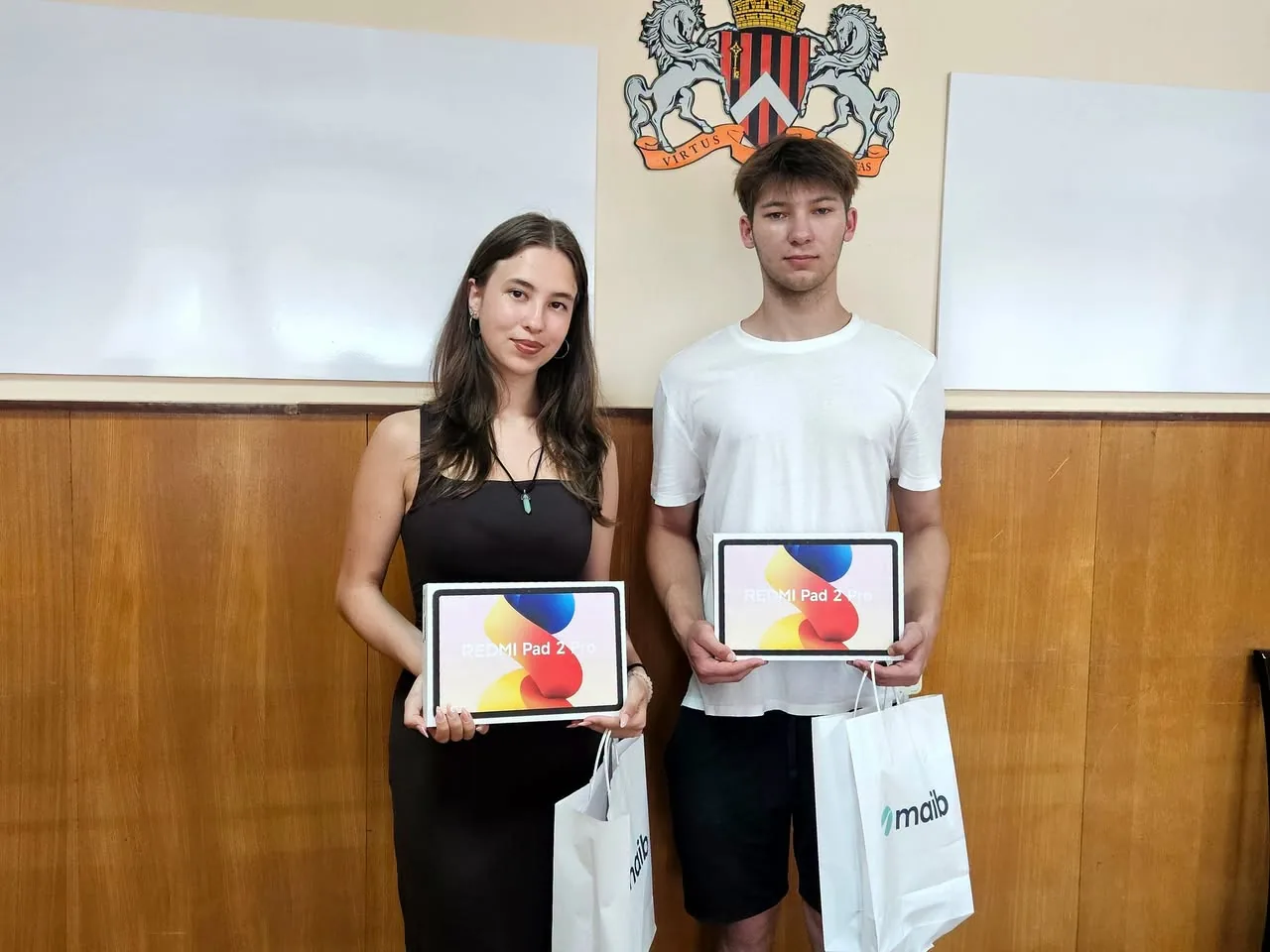
On Tuesday, 23 June, in a hall of the Ungheni city hall, two recent high-school graduates each received a tablet. Sorina Iachimovschi, a graduate of the Gheorghe Asachi Lyceum, and Maxim Angheluță, a graduate of the Ion Creangă Lyceum, were recognised by the local administration together with the bank MAIB (Moldova Agroindbank) for their civic engagement — for the hours of volunteering and the initiatives they carried out at the Ungheni Municipal Youth Centre.
Taken at face value, it is a few-line story: a protocol photo, two boxes holding a REDMI Pad 2 Pro tablet, a bag with the bank’s logo. But the gesture rests on something larger and more interesting than itself — a whole infrastructure through which a provincial town has been trying, for years, to convince its young people to stay. And the question in the background is not whether two tablets are worth it, but whether all this machinery actually makes a difference in a district that loses its young generation year after year.
What the Municipal Youth Centre actually is
The two awardees did not come out of nowhere. The Ungheni Municipal Youth Centre is a real institution, registered in the national network of youth centres of the National Youth Agency, based inside the Palace of Culture on Nicolae Bălcescu street. In its official description, it is “a space for the municipality’s young people, where creativity, initiative and civic spirit are encouraged” — in practice, a place that hosts career-guidance sessions, media-literacy and entrepreneurship workshops, exchanges with young people from other towns, and volunteering activities.
It is not an empty showcase. In recent weeks the centre’s channels have announced a series of career talks — including one on the financial sector — workshops on turning a passion into a business, and an exchange with young people from Dorohoi, across the Prut. Sorina and Maxim are a product of this environment, not the winners of a lottery.
A necessary clarification, to avoid confusion: Ungheni has two distinct youth centres. The municipal one, run by the city hall, which is the subject here, and the district one, run by the district council — which, separately, also awarded its own volunteers at the Graduates’ Ball last week. They are different structures, with different events.
A town that bet on youth twice
Public recognition of volunteering is no passing whim in Ungheni. The town has built an identity around its young people: it held the national title of “Youth Capital” in 2023, with a programme launched in April and backed by the state budget with around 1.3 million lei, and the contest’s very first edition, in 2011, was also won by Ungheni.
An ecosystem has formed around that status: youth NGOs active in the town, a municipal grants programme through which the administration funds the initiatives of youth organisations and groups — set up by a Municipal Council decision in 2025 and updated in March 2026 — and externally funded projects. Here too, in Ungheni, an initiative group from the Gheorghe Asachi Lyceum — the same lyceum Sorina graduated from — secured a grant a few years ago through the YouCreate programme, funded by UNFPA and the Swiss Cooperation Office, to set up an open-air study room. In other words, Tuesday’s tablets are not an isolated gesture but the visible tip of an entire engagement machine.
The stake: who, exactly, they are trying to keep
This is where the part that gives weight to an otherwise minor story comes in. All this effort unfolds against a demographic haemorrhage that the figures state bluntly.
According to the National Bureau of Statistics, the number of 20–24-year-olds in the Ungheni district fell from 8,297 at the start of 2014 to 3,111 at the start of 2026 (preliminary data) — a 62% drop in a single decade. This is precisely the age bracket in which a lyceum graduate decides whether to stay home or leave for study and work. The next generation, the 15–19-year-olds, is also smaller than ten years ago (5,174 against 7,340 in 2014), though it has stabilised slightly in recent years. And the district’s entire population fell over the same period from roughly 96,500 to about 74,000.
The decline has several overlapping causes — the low birth rate of two decades ago and departures for study and work, in Chișinău or abroad. But the effect is the same: with every cohort that climbs onto the stage, a significant part vanishes from the district’s statistics in the years that follow. Against this backdrop, a programme that rewards young people who choose to get involved at home stops looking like an image detail and becomes a stake in the community’s survival.
The two awardees describe, in simple words, exactly what the administration would like to cultivate.
Volunteering is wonderful. It is a way to grow, to get to know yourself, to get involved.
Sorina Iachimovschi, graduate of the Gheorghe Asachi Lyceum
For me, volunteering and getting involved mean helping without asking for anything in return.
Maxim Angheluță, graduate of the Ion Creangă Lyceum
A banking partner and a local gesture
The award did not come from the local budget alone. The partner in the gesture was MAIB, the largest bank in the Republic of Moldova, represented at the event by Valeriu Moraru, head of the Ungheni branch. For banks, sponsoring education and active young people is familiar social-responsibility terrain: MAIB has run scholarship programmes for pupils and students and financial-education partnerships for years. The Ungheni tablets fit this logic, though, unlike the scholarship programmes the bank announces publicly, the gesture here looks more like a one-off initiative of the local branch, in partnership with the city hall; on the bank’s official channels we did not find a standard “tablets for active graduates” programme replicated across several localities.
At the award ceremony, mayor Vitalie Vrabie summed up the message the administration is betting the young people will carry forward.
Learn to become better. Give. You must first give, in order to expect something to be offered to you.
Vitalie Vrabie, mayor of Ungheni
For Sorina and Maxim, the tablet is a study tool and a sign that their effort was seen. For the town, it is a small bet in a much larger contest — to remain a place where it is worth being young. Whether the bet pays off will be told, in a few years, by exactly the figures that today show a district growing ever emptier of its twenty-somethings.
The figures on young people in the Ungheni district come from the National Bureau of Statistics (table POP010400rclreg.px, preliminary data for 2026). The award itself is documented from the official 23 June 2026 post of the Ungheni City Hall, which contains the quotes from the two graduates and the mayor. At the time of writing, the number of volunteers and yearly projects of the Municipal Youth Centre, its budget, and the annual amount of the municipal youth grants programme were not published — the sums do not appear in the council decisions, but at most in their annexes.