
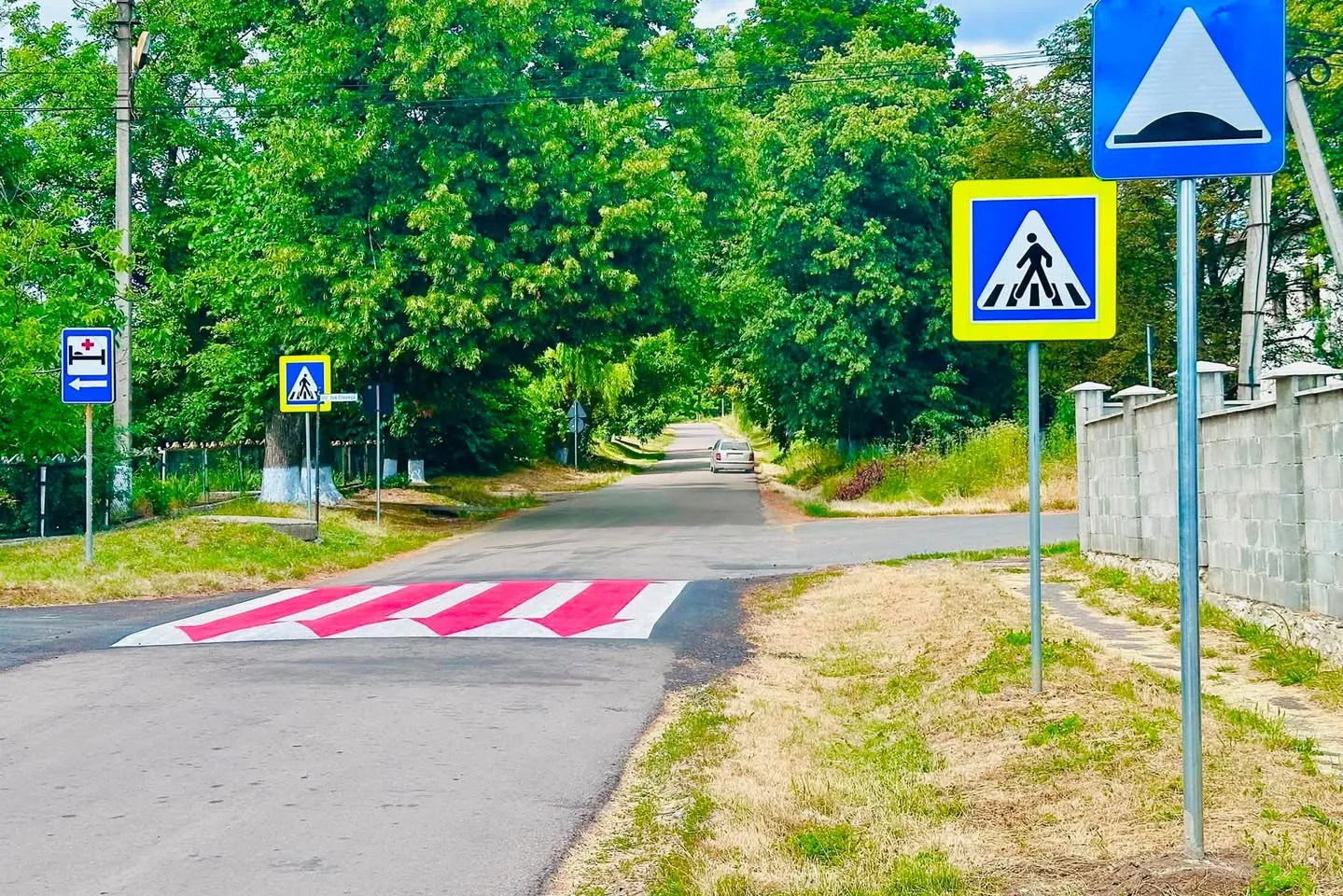
At the junction of Ion Creangă and Alexandru cel Bun streets in Sculeni — right where the theoretical lyceum, the Arts School and the Health Centre stand together — a raised pedestrian crossing has appeared: a wide platform with red-and-white markings that cars are forced to cross slowly. It is the kind of measure that does not rely on a driver’s goodwill, but physically makes him lift his foot off the accelerator.
The work — with crossing and bump warning signs installed on either side — was carried out by the National Roads Administration. The starting point, the commune hall says, was an initiative by councillor Petru Iacobciuc, turned into an official request from the local administration to the road authority.
Why the location matters
The junction was not chosen at random: it is where the commune’s most vulnerable pedestrians pass every day. The Sculeni theoretical lyceum alone has 578 pupils, according to the scoalamea.md portal, and its address — 3 Ion Creangă Street — is right at the junction that was redone. Next to it, the Arts School and the Health Centre bring children, parents and patients into the same area.
District statistics show why such measures are not a whim. In 2024, road accidents in the Ungheni district killed 5 people and injured 23; in 2023, 11 were killed and 35 injured, according to General Police Inspectorate data passed to the National Bureau of Statistics.
The second intervention in the commune in a month — and precisely the “tough” one
Sculeni was in this position just a few weeks ago, but with a weaker solution. In June, on the R16 national road, by the Gherman gymnasium in the same commune, a pedestrian crossing was painted — but a flat one, just paint, signs and a 30 km/h limit. We wrote at the time that the state had turned, “when it really wanted to protect pupils”, to raised crossings — the ones that force drivers to slow down — and that at Gherman “there is no such bump”.
At the junction by the Sculeni lyceum, that very bump has now been built. The difference between the two interventions is not cosmetic: a flat crossing asks a driver to brake, a raised one makes him brake.
The work is part of a national programme through which the National Roads Administration installed raised crossings on national public roads “especially near schools”. The institution — reorganised a year ago from the former State Roads Administration — is the manager of national roads, and the fact that it carried out the work shows that the junction lies on such a route, running through the village.
Not everything looks finished yet. In the comments under the commune hall’s post, one resident notes that the “kerb-to-kerb” arrangement is supposedly complete only on the Health Centre side, not the other — a single voice we could not verify on the ground, but a point to watch. It does not, however, contradict the basic fact: the raised crossing exists and does its job, forcing cars to slow down exactly where the most children gather.
The notice and the photos come from Sculeni commune hall. The number of pupils at the Sculeni theoretical lyceum is taken from the scoalamea.md portal, and the district road-accident figures from the National Bureau of Statistics. The cost of the work, the date of the request to the National Roads Administration and the exact index of the national road the junction sits on have not been made public.