
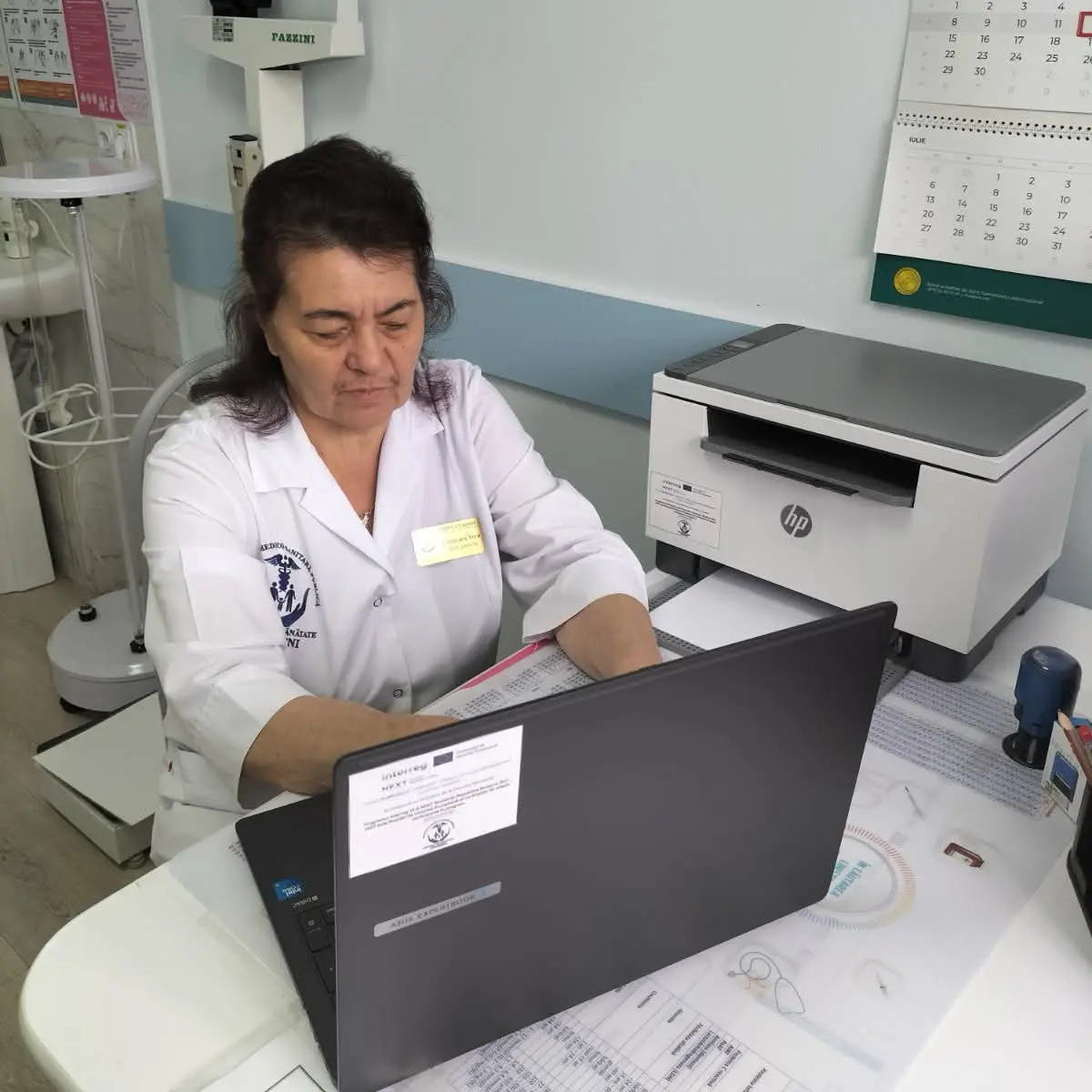
Fifteen family doctors in the Ungheni district have received laptops and printers. The announcement, made by the Ungheni Health Centre, sounds like minor logistics — yet another equipment handover. But behind the devices stands a project with a far larger ambition: to change the way family medicine works, shifting it from treating disease once it has set in to catching it early.
What «PREVENT» is
The equipment comes through a cross-border project called «PREVENT», funded by the European Union via the Interreg VI-A NEXT Romania–Republic of Moldova cooperation programme. The Ungheni Health Centre runs it together with two partners from Iași: the city of Iași, as lead partner, and the «Grigore T. Popa» University of Medicine and Pharmacy. The project began in October 2025 and runs until April 2027, with a total budget of almost 415,400 euros, nine tenths of which is non-repayable European money.
The laptops and printers are, then, only the tool on the ground: they help the fifteen doctors keep records more easily, reach digital resources and communicate better with patients. The project’s stake, however, lies in what the doctors will do with this support.
The stake: medicine that catches disease before it hurts
«PREVENT» puts at its centre a word the medical system says often but practises with difficulty: prevention. The idea, according to the statement, is to build — together, on both sides of the Prut — guides and campaigns that help family doctors detect early the diseases that, untreated, cost the most, in lives and in money.
The list the project targets says everything about its logic. In the foreground are the «silent» cancers — those that give no symptoms until it is too late: cervical, breast and colon cancer, all detectable through screening, that is, through check-ups done before a person feels ill. Alongside them, metabolic syndrome, cardiovascular and chronic respiratory diseases. Plus mother-and-child prophylaxis. These are precisely the areas where a timely check-up makes the difference between a manageable disease and a late one.
What the district actually gains
Family medicine is the first door a patient knocks on — and, often, the only one they open in time. A prevention system that works there means cancers caught at treatable stages, blood pressure and diabetes kept under control before complications, fewer people ending up in hospital with diseases that could have been stopped. For the Ungheni district, the fact that prevention is entering the attention of fifteen family-doctor practices — with technical support and with guides developed alongside a university centre in Iași — is a real gain, on condition that the project moves from equipment and guides to check-ups actually carried out.
The project also provides for research into the prevention behaviour of the people of the Ungheni district and of Iași, as well as of the family doctors on both sides. What this research shows — how often the people of Ungheni go for a check-up before they feel unwell — will probably be the most telling part of «PREVENT». For now, what has happened is the beginning: the devices have reached the doctors, and the hard part — changing the habit of going to the doctor only when it hurts — is yet to come.
The information about the «PREVENT» project — partners, a budget of 415,384.80 euros, the October 2025 – April 2027 period, the screening and prevention objectives — comes from the public statement of the IMSP Ungheni Health Centre, a partner in the project, and refers to a project funded by the Interreg VI-A NEXT Romania–Republic of Moldova programme. Triunghi.md had not, by the time of publication, obtained independent data on the number of screening check-ups carried out so far in the Ungheni district under the project; these remain to be followed as «PREVENT» progresses.