

In a yard on the hill of the village of Boghenii Vechi, a woman in a headscarf fills two aluminium canisters straight from a tap newly fitted into the wall. These are the images the commune hall published itself, and they say without words what has changed: in the upper part of the village, where water did not reach, it now runs from the tap.
The Boghenii Noi commune hall announced on 22 July that it had completed the full connection of the village of Boghenii Vechi to the commune’s water main, “including” the residents “in the hill zone”. With this, the administration says, all four of the commune’s villages — Boghenii Noi, Boghenii Vechi, Poiana and Mircești — receive water from the same system, supplied from the Zagarancea source.
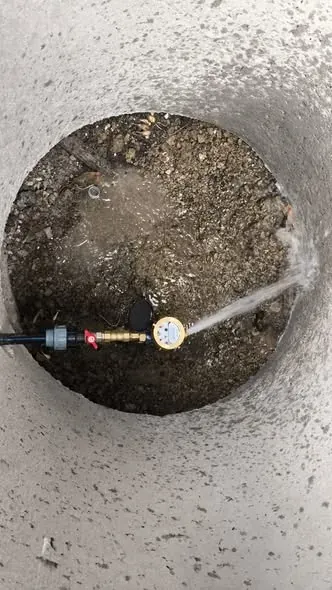 The meter installed at a connection in Boghenii Vechi. Photo: Boghenii Noi commune hall.
The fact leaves a trace in the numbers. In the database of the National Bureau of Statistics, the village of Boghenii Vechi shows no public water network at all in the years 2016–2024. Only in 2025 does it get an entry: 3.1 kilometres of network and 59 connected dwellings. In the same year the commune’s other villages also come onto the map — Poiana with 98 dwellings, Mircești with 88 — while the centre, the village of Boghenii Noi, rises from 128 to 132. In a single reporting year, the commune goes from “only the centre has water” to a network stretched across all its villages.
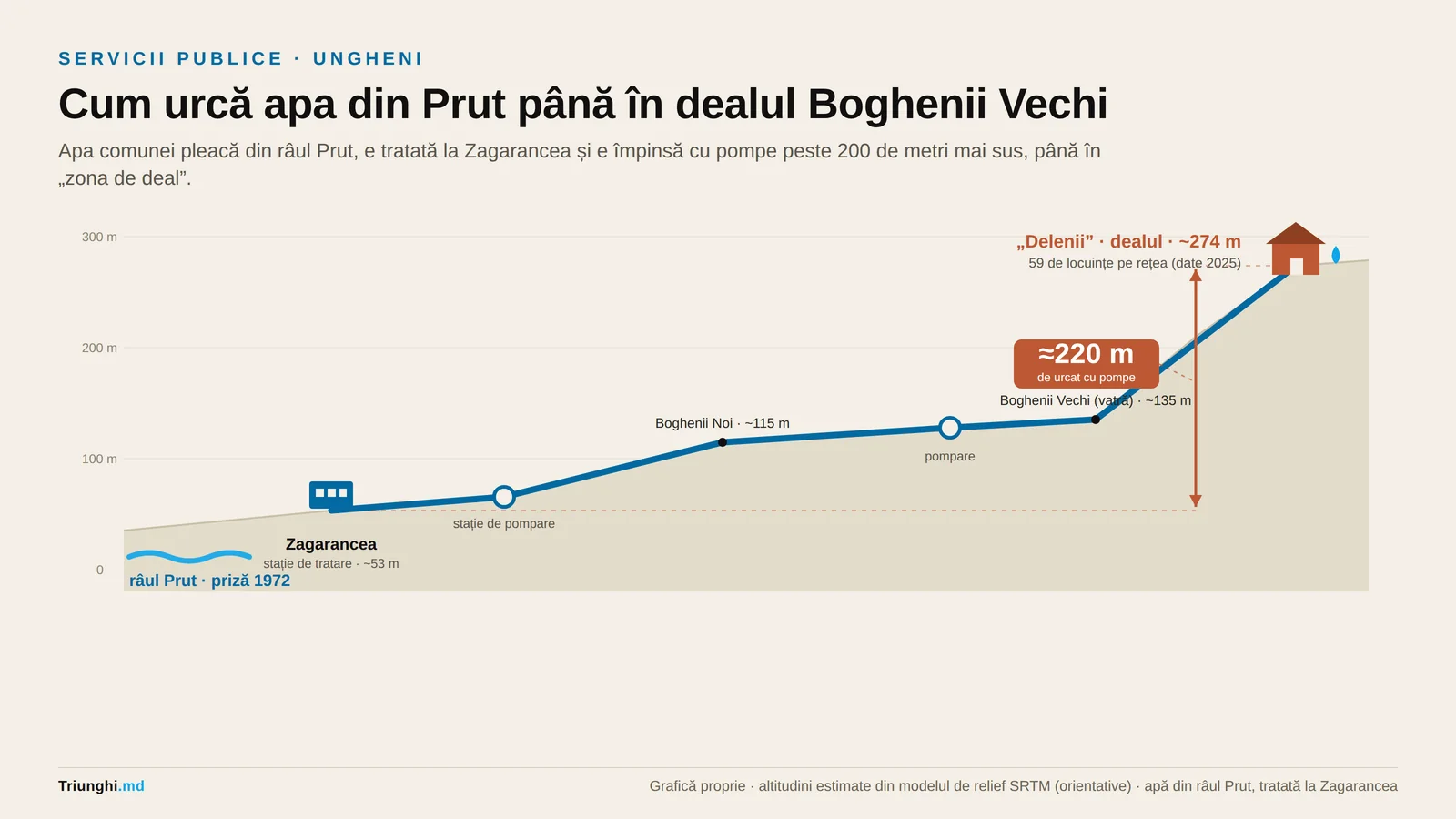
The water that climbs more than 200 metres
To understand why the “hill zone” was the last, it is enough to look at the altitudes. The commune’s water starts at Zagarancea, where it is drawn from the Prut river — through an intake built in 1972 — and treated. The intake sits at about 37 metres above sea level, and the station at some 53. The core of the village of Boghenii Vechi lies at roughly 135 metres, while “Delenii” — the upper part, which spells out its own problem in its name, “the hill people” — climbs up toward 274 metres.
Between the source and the highest tap there is, then, an elevation difference of more than 200 metres. Water does not climb the hill on its own: it has to be pushed with pumps and pressure. That is why high elevations are, everywhere, the last to be connected and the most fragile — and why the region’s water projects needed new pumping stations. (The altitudes are estimated from a public terrain model and serve to illustrate, not as a topographic survey; the difference between valley and hill, however, is certain.)
It is not a local quirk. In the district itself, the neighbouring village with the same problem is Petrești, where residents of the “hill zone” complained this summer that they go days without water, at peak hours and during heatwaves. High elevation means low pressure; low pressure means a dry tap precisely at the top. Getting water up the hill is the hard part of any village water main.
Where the water actually comes from
The “Zagarancea source” is not a well belonging to the commune, but a water node for much of the district. The same intake on the Prut and the same station at Zagarancea supply the municipality of Ungheni and a string of surrounding localities as well. The tap on the hill of Boghenii Vechi and the tap in a town apartment begin, literally, in the same river.
How the water reached the commune can be read in the local council’s records. The centre — the village of Boghenii Noi — already had a water main: in March 2025, the councillors transferred to the commune hall’s direct management the “water main in the village of Boghenii Noi”, valued at over 1.8 million lei. Also in 2025, the commune joined a regional project financed from the National Fund for Regional and Local Development (FNDRL), named in the decisions “Group water-main system … 8 localities of the Ungheni district”, on the basis of a financing contract from November 2024. The commune did not put this network out to tender on its own — it came through the regional project and through money from the district.
This is where the thanks the mayor Veaceslav Cernei addressed to the District Council fit in. In a report on the spring council session, we noted that, in May 2026, the Ungheni District Council allocated 591.3 thousand lei from the balance left at the end of last year for several purposes — among them “a water-main connection at Boghenii Vechi and Izvoreni”. The sum is the total of the allocation, not the cost of the works at Boghenii Vechi; but it shows that the district support the mayor is thanking has backing in the records, not only in words.
What the mayor clarified
After the article was published, the commune’s mayor, Veaceslav Cernei, told us by phone how the water was brought into the commune and what “complete connection” meant technically.
The network was built in stages, out of a crisis. In the spring of 2024, the mayor says, the single well supplying the commune broke down, and only the village of Izvoreni still had water, from a spring. The commune then hooked up to the regional system through the reservoir at Cornești, with the support of the district council and the environmental authority. The first village connected was Mircești, in the autumn of 2024, then Poiana, in the winter of the same year; Boghenii Vechi followed — first the valley part, and now the “hill zone” too has been completed.
To make the water climb to the high elevations, the commune built a pumping station connected to the line coming from Zagarancea, and fitted five pressure regulators — so that the high pressure would not burst the pipes on the slope. On the hill, the mayor says, there are “at most three houses” left to connect, sitting far apart from one another.
The figures on people are close to the statistical ones: around 60 households connected in the valley in the previous year — as the official reporting for 2025 also shows — another ten this year and a further 20–30 pending. On the money, the mayor makes an important clarification: the 591.3 thousand lei allocated in May by the district council “do not concern this work directly”, but covered several purposes. For the Boghenii Vechi connection, he says, the commune also put in money from its own budget, on top of the district support and the regional group water-main project.
”Water at the tap” is not the same as “drinking water”
A clarification owed to any reader getting ready to drink from the new tap. The tariff approved by the communal council in April 2026, for the service provided by the district operator Î.M. “Apă-Ungheni”, is for technical water — 30 lei per cubic metre for households. Technical water is fine for washing, cleaning, the garden and animals, but it is not guaranteed as drinking water.
Connection to the treated source at Zagarancea is precisely the step that can raise this quality toward drinking water — but whether the water delivered in the commune today is tested as potable, with what certificates and from what date, are things only the commune hall and the operator can confirm. Until confirmed, “water at the tap” remains real progress, without automatically being “drinking water”. It is the distinction that separates a network endpoint from a safe glass. In his clarifications, the mayor spoke of the network, pumping and pressure, not of drinking-water quality.
One village, in a process that spans years
Seen from the country’s vantage, connecting a village is not an exception but the rule of these years. In 2024, 65.6% of Moldova’s localities had access to a public water main — 1,006 localities, of which 951 rural — up from 920 in 2021. Of the 561 kilometres of new network put into operation that year nationwide, 507 were in rural areas. The village, not the town, is where most metres of pipe are now being dug.
The gap remains, but it is closing. In 2024, 71.9% of rural households had a water main inside the dwelling, compared with 96.5% in urban areas; five years earlier, in 2019, the rural figure was 55.3%. The North region fares the worst, with only 51% of its localities connected. In this picture, the 59 dwellings in Boghenii Vechi are one of the thousands of connections added, year after year, to the water map.
What the numbers do not yet show, precisely, is the cost of this particular work and how it breaks down by source: there is, for now, no entry — in the commune’s records, the district’s, or the public-procurement system — for how much connecting Boghenii Vechi cost and who paid how much. The mayor gave us the outlines — district support, money from the commune’s own budget, a regional group water-main project. The number of households, by contrast, is beginning to take shape: a few dozen already connected in the valley, a few houses left on the hill.
In the yard on the hill of Boghenii Vechi there is now a tap that, until recently, did not exist.
The completion announcement and the photographs come from the official page of the Boghenii Noi commune hall. The data on the network, connected dwellings, population and access to the water main come from the National Bureau of Statistics; the figure of 59 dwellings is the one reported for 2025 and may rise in later reporting. The water source, the year of the intake and the tariff for technical water come from the operator’s technical description and from the communal council’s decisions published on actelocale.gov.md. The altitudes are estimated from a public terrain model (SRTM) and are indicative. The mayor’s name is confirmed from the official results of the 2023 local elections. The clarifications on the chronology, the pumping station, the pressure regulators and the number of households were provided to the newsroom by phone by mayor Veaceslav Cernei on 14 August 2026, in response to our request for public-interest information. Article updated on 14 August 2026.