

Update — 5 September 2026. The Cioropcani commune council voted the amalgamation on 10 August, by decision no. 06/03 — three days later than the date announced on 31 July by the head of the Ungheni Territorial Office. With that vote, all four councils of the Sculeni group have an approval decision: Sculeni and Buciumeni on 30 July, Taxobeni (Fălești district) on 31 July and Cioropcani on 10 August. The text below reflects the situation as of 2 August 2026.
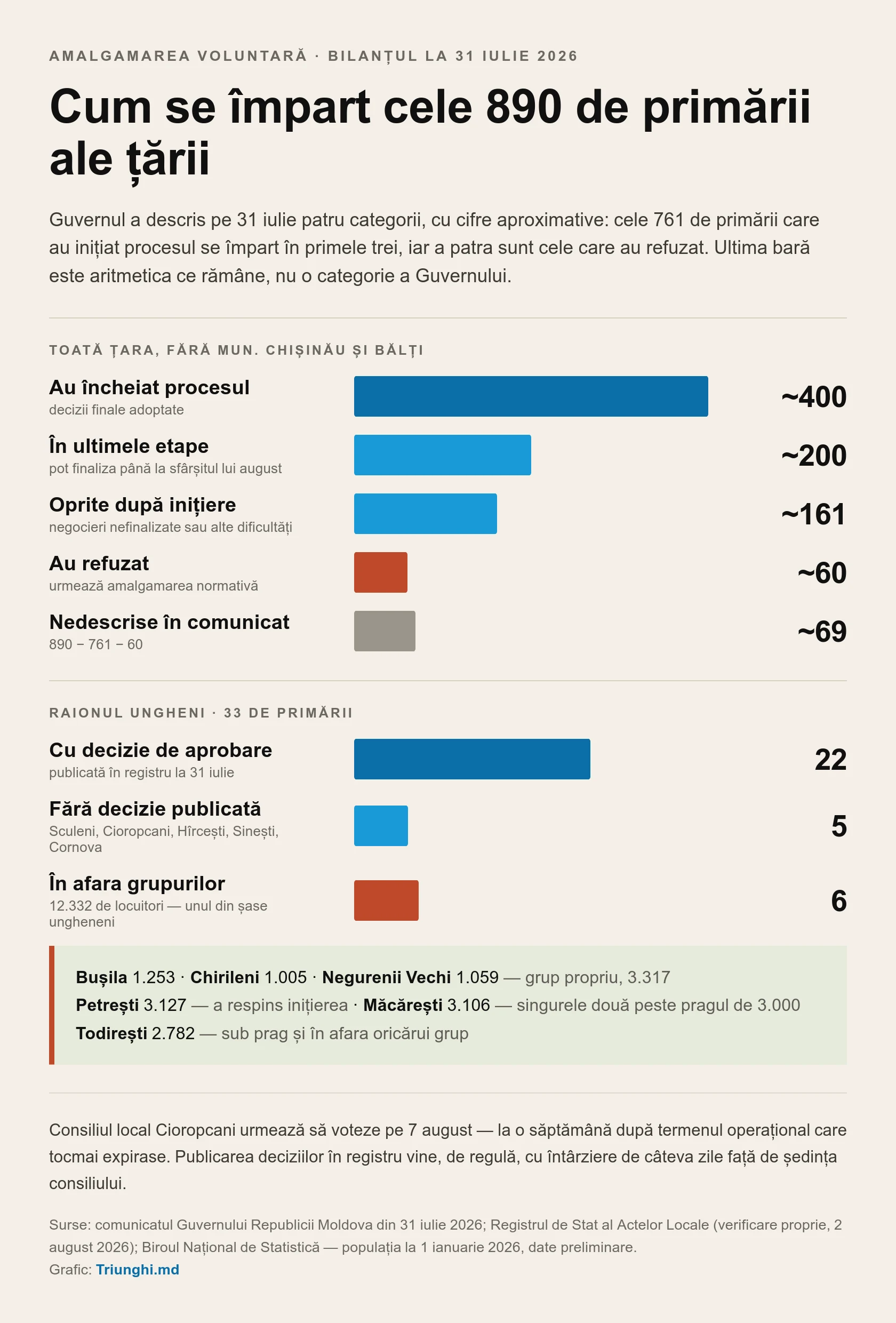
The Government presented its stocktaking of voluntary amalgamation on 31 July, on the day the deadline it had itself set expired. Of the country’s 890 mayoralties, excluding the municipalities of Chișinău and Bălți, 761 — that is 85.5% — adopted initiation decisions, and around 400 also adopted their final decisions. The process did not stop with the deadline, however: another 200 or so mayoralties have held the public consultations, prepared most of the documents and, the Government writes, “will be able to complete the process by the end of August”, keeping the voluntary amalgamation status and the whole package of incentives.
In Ungheni district, 22 mayoralties had their final decision published in the register on 31 July. Five did not have it, and six were left outside the five amalgamation groups.
Four categories, at national level
The press release gives three figures for the 761 mayoralties that started the process: around 400 with final decisions, around 200 in the last stages and around 161 halted after the initiation decision, “because of unfinished negotiations or other difficulties”. The three figures, although given as approximate, add up to 761. The Government says it will continue to offer legal and technical assistance to those that have halted.
The fourth category falls outside this total: around 60 mayoralties refused to take part in the voluntary process, and for them “the normative amalgamation stage follows”. Since 890 minus 761 leaves 129 mayoralties with no initiation decision, and the press release describes around 60 of them as refusals, the remaining almost 70 are left in no category at all.
The case for the reform, as the Government puts it, rests on three figures: over 87% of the country’s mayoralties have fewer than 3,000 inhabitants; 8 out of 10 families with no access to water or sanitation live in localities administered by those mayoralties; and the population of these communities has fallen by a third, twice as fast as the national average.
Only through strong mayoralties can we ensure quality public services, modern infrastructure and real investment in local development. The Government chose voluntary amalgamation first and foremost because local elected officials know best the development priorities and the needs of the citizens in their communities. Alexei Buzu, Secretary General of the Government
What the district’s 33 mayoralties look like
The press release gives no breakdown by district. We reconstructed the picture from the acts published in the State Register of Local Acts.
The district has 33 mayoralties. Twenty-seven are taken into five amalgamation groups — around Ungheni municipality, around the communes of Pîrlița, Boghenii Noi and Sculeni and around the town of Cornești — and six were left outside them.
Of those 27, 22 had their approval decision published in the register on 31 July. For the other five — Sculeni, Cioropcani, Hîrcești, Sinești and Cornova — the register held, at a fresh check made on 2 August, only initiation decisions, transfer requests and, in two cases, acts on the public consultations. The register’s search engine indexes act titles, not their bodies.
The absence of a decision from the register does not necessarily mean that a council did not vote: publication comes, as a rule, with a delay of several days. At Cioropcani, however, it is clear that the vote had not taken place — in a post of 31 July, published on the page of the Cioropcani commune City Hall, the head of the Ungheni Territorial Office, Ion Poia, wrote that “on 7 August the Cioropcani local council will also give its view”. A locality in the Sculeni group is voting a week after the deadline that had just expired — precisely in the window opened by the extension to the end of August.
The six mayoralties outside the groups have 12,332 inhabitants between them on 1 January 2026 — one in six people in Ungheni district.
Three of them, Bușila, Chirileni and Negurenii Vechi, started a process of their own, the three together, and add up to 3,317 inhabitants on 1 January 2026, above the legal threshold. Todirești has two initiation decisions of its own, of 15 May and 5 June, with no approval decision. At Măcărești, according to the City Hall’s announcement, the vote of 16 June failed to gather the necessary votes, and no decision from the extraordinary sitting convened for 22 June had reached the register by 31 July.
Petrești, the only one to reject the initiation
A single mayoralty in the district rejected the initiation of amalgamation through a council decision published in the register. On 27 May, the Petrești Communal Council rejected the proposal to initiate the process — 10 votes for rejection, two abstentions.
The decision is not a formality. The preamble invokes the opinions of the local councillors and the interests of the community, and the factual ground is the commune’s general assembly of 17 May: the act finds that the inhabitants do not agree with the administrative-territorial reform. The reason is tied to a figure — according to the 2024 census the commune has 3,185 inhabitants, above the threshold of 3,000 that the law requires of a unit resulting from amalgamation. The act sets the limits of its own validity: the finding is made for the current stage.
The National Bureau of Statistics series, which comes from a different source than the census, gives Petrești 3,127 inhabitants on 1 January 2026. Both figures are above the threshold.
Of the six mayoralties left outside the groups, only Petrești (3,127) and Măcărești (3,106) are above the threshold of 3,000. The other four are below it — but three of them, Bușila, Chirileni and Negurenii Vechi, have grouped together and reach 3,317 between them. That leaves Todirești, with 2,782 inhabitants: below the threshold and outside any group.
The framework described so far ties normative amalgamation to mayoralties below 3,000 inhabitants. What happens to the mayoralties that refused the voluntary path but are above the threshold does not follow from the press release.
What is at stake in August
What is at stake in the coming month is the package of incentives. Mayoralties that complete the process by the end of August keep the voluntary amalgamation status; those that do not, according to the written reply the Ungheni Territorial Office gave the newsroom on 20 July, before the new deadline was announced, “will no longer be able to benefit from the voluntary mechanisms and will subsequently be amalgamated under the rules on normative amalgamation”. The date of 31 July was not a legal deadline but an operational one, set by the State Chancellery — and so is the one in August.
The money from the Amalgamation Fund goes, according to the Government, towards extending water, sewerage, gas and street-lighting networks, repairing local roads, public transport, digital services, waste management, modernising kindergartens and houses of culture, and local economic development projects. The priorities were gathered, the press release says, through more than 88,000 direct interactions with citizens and more than 75,000 questionnaires, across the whole country.
The Cioropcani local council is due to give its view on 7 August. The files that reach the State Chancellery are examined and approved there, and the new administrative-territorial units are established by law. Local council decisions may be challenged within 30 days of communication, at the Ungheni municipal court.