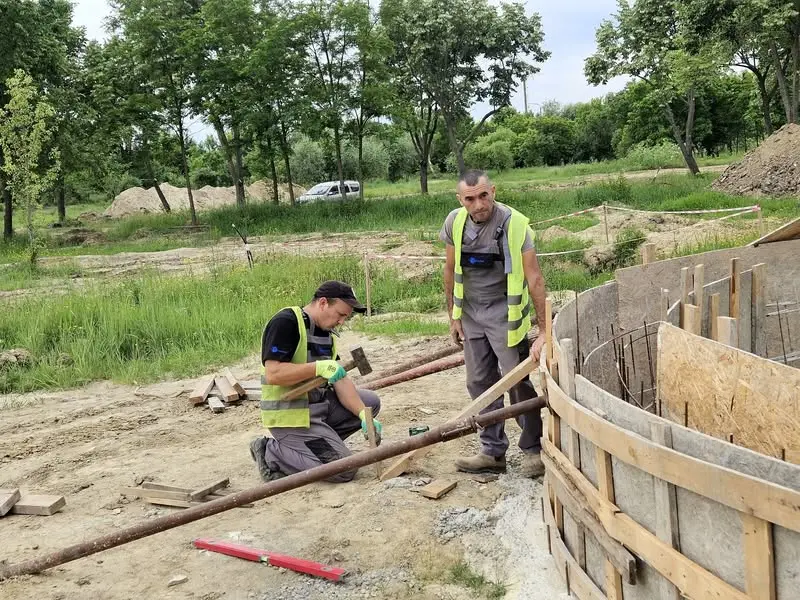
The largest green space of the Ungheni municipality, the French Park on the bank of the Prut, is a full building site. After the underground networks were laid, the works moved into the visible part: the parkour zone, the skatepark and the water-retention basins are taking shape. Mayor Vitalie Vrabie, present on site, said he was pleased with the progress.
What the park will have
According to the City Hall, on about four hectares there will be 5,217 square metres of sports grounds — for volleyball, basketball, mini-football, table tennis, tennis and even padel, an increasingly popular racket sport. To these are added playgrounds for children by age category, cycling paths, running tracks, pedestrian alleys and lighting. The rest of the park — which covers, in total, almost 14 hectares — remains, for the most part, untouched.
Where the money comes from
The works are being carried out through two parallel projects. The first, “Regeneration of the French Park through the integration of green and smart solutions”, is implemented by the Government through the Centre Regional Development Agency, with money from the National Fund for Regional and Local Development and a contribution from the City Hall. The second, called UCare, is part of the European Interreg NEXT “Black Sea Basin” programme and has a budget of almost 1.47 million euros, of which 90% (over 1.3 million euros) comes from the European Union; on this project, Ungheni works alongside the towns of Tulcea (Romania) and Thermi (Greece).
How much does it all cost, in fact? The figures in circulation differ depending on what is being counted. The City Hall announces a total investment of “over 33.5 million lei”, the ADR Centru director, Ion Pînzari, spoke at the launch of about 34 million, and the works contract, awarded to the firm Aflux-Prim, is about 25.7 million lei, with an 11-month term. This is public money, national and European, all the more reason to track the exact breakdown to the end of the works.
Climate, not just leisure
The official name of the European project, in fact, gives away its point: adapting the town to climate change. The retention basins are not a whim — they hold rainwater; permeable surfaces let water soak into the soil instead of running off; and the preserved vegetation reduces the “heat island” that asphalt creates in summer. Besides Ungheni, Tulcea and Thermi, the Regional Centre for Sustainable Development in Ungheni also takes part in the project.
The trees: only the sick ones
The natural question with any park “redevelopment” is how many trees fall. Here, the answer was prepared before the first cut: the entire 13.9-hectare area was scanned by drone by a team led by Dr Ion Roșca, director of the “Alexandru Ciubotaru” National Botanical Garden in Chișinău, for an inventory of the trees and their health. According to the organisers, only diseased or pest-damaged trees are cut, and new trees will be planted in coordination with the Botanical Garden. The works also have the environmental permit issued by the Environment Agency in March 2025.
Why “French”?
Finally, the question many Ungheni residents ask: why “French”? The name has been used for more than six decades, but its origin is undocumented. Only in 2024 did the Municipal Council make it official by a vote, after public consultations. Beware, though, of a tempting confusion: Ungheni’s French twin town is Andrézieux-Bouthéon, but the twinning dates from 2016 — long after the park already had its name. The two are therefore unrelated.
Update — 20% of the works, at the first technical progress meeting
On 8 July, Mayor Vitalie Vrabie convened a technical meeting with all the decision-makers involved in the project, to review the works carried out, the problems that arose and their solutions. According to the City Hall, 20% of all planned works had been completed at that point — but, the organisers say, some of the most complicated and complex operations have already been done. The mayor asked the designer and the contractor to keep working together so that the French Park „truly becomes an attraction for a great many people”. It is the first public progress marker since the works began.
The figures on the features and the value of “over 33.5 million lei” come from the Ungheni City Hall’s statement. The value of the works contract (about 25.7 million lei) and the total quoted at the launch (about 34 million) come from press reports and the ADR Centru statement — the differences relate to what is being counted (works contract vs. total project value) and remain to be clarified at the end of the works. The data on the European UCare project are from the official Interreg NEXT programme database. The park’s area (13.9 ha) and the details on the tree inventory come from the project’s official bulletin. Update, 8 July 2026: at a technical meeting convened by the mayor, the City Hall announced that 20% of the works were complete.