
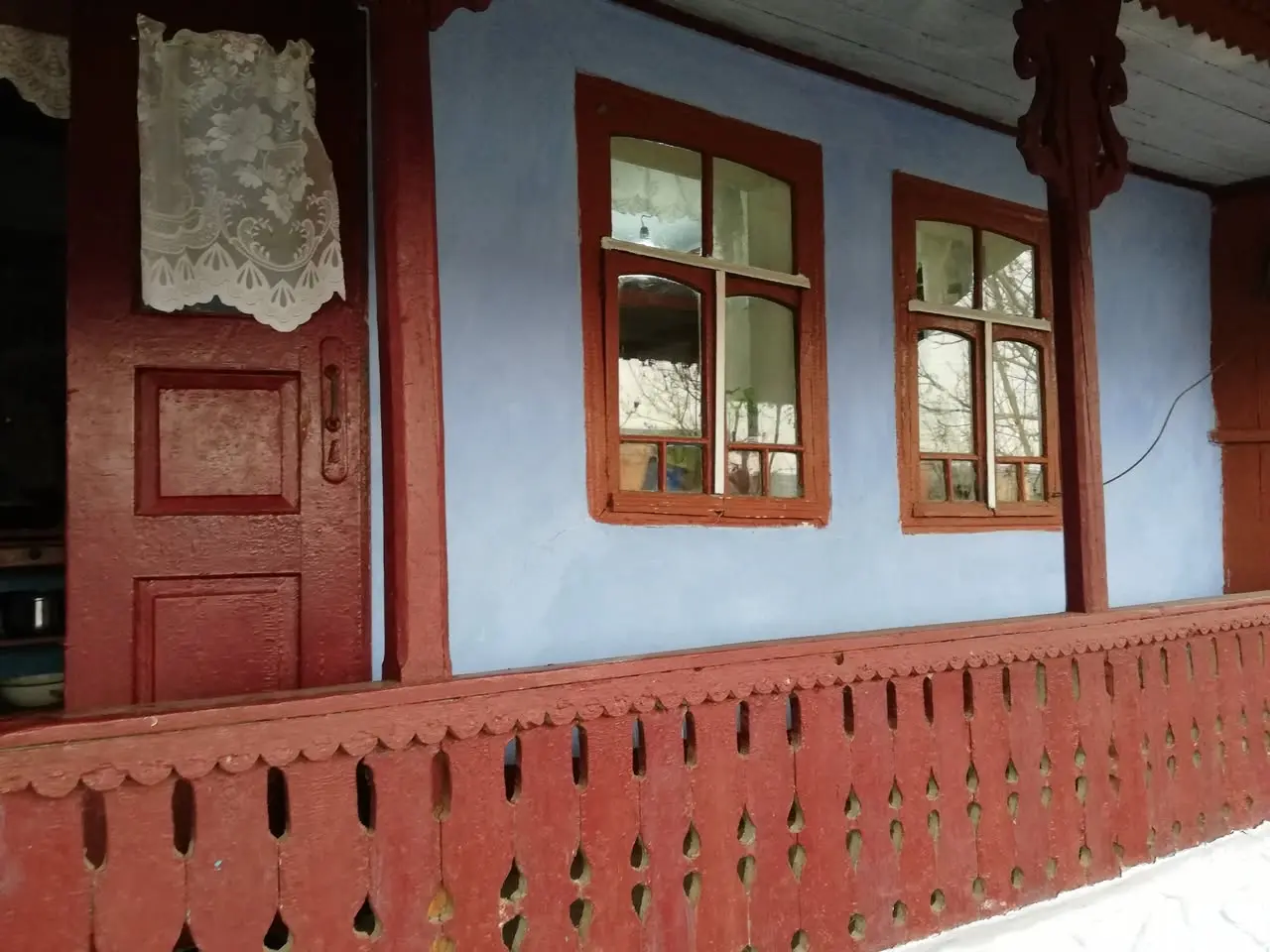
A post by the Ungheni Culture Section turned, within a few days, from a photo gallery into a small local event: images from a peasant house kept intact in Florițoaia Nouă, a village of Florițoaia Veche commune. A porch with wooden pillars, a rail hung with headscarves above the bed, an icon with its lamp in the corner, the kneading trough, the pots, the oven. In the comments, people thank the woman who has kept everything «devoutly». The house belongs to a woman from the village whom we do not name — the story here is not about her, but about what she keeps alive.
Because, read carefully, such a house is not a picturesque backdrop, but a text. Each object in the pictures has a name and a purpose, and ethnographers described them long ago.
How to read a peasant house
Researcher Ludmila Fulea, of the Institute of Cultural Heritage, has mapped precisely these elements in her studies of the rural dwelling in the area between the Prut and the Dniester. The prispă — or porch — narrow and as long as the façade, with carved wooden pillars supporting the roof, was the threshold between the yard and the house. Inside, «the rail was above the bed, where the inhabitants kept their clean clothes»; the painted dowry chest stood at the foot of the bed; the shelf by the door held the pots, bowls and wooden spoons; and the icon was placed «in the corner to the east». The bread oven, in the hallway, was lit once a week.
The heart of the house was the «casa mare» — the most carefully kept room, which Fulea calls «the most conservative space», reserved for guests and the great passages of life: baptism, wedding, funeral. There the best woven cloths, the carpets, the folk costume, the dowry were gathered. It is no coincidence that the National Museum of Ethnography and Natural History has a permanent exhibition named exactly «The Casa Mare. The Wedding». A second Academy researcher, Natalia Grădinaru, ties the knowledge of this architecture to «the continuity of the native population» — that is, to the memory of a place.
In plain terms: what the Culture Section photographed in Florițoaia Nouă is not old objects, but a whole grammar of how the grandparents lived. «The house is a shelter for the soul», Fulea writes, quoting the ethnographer Ion Ghinoiu.
Heritage under glass and heritage still alive
The Ungheni district does not lack such testimonies — on paper. The History and Ethnography Museum in the town gathers over ten thousand items, from folk costume to rugs and tools; the museum in Pârlița commune presents as many as two traditional peasant houses; and in Sculeni there is another history and ethnography museum. The difference is that those are houses taken out of life and put under glass, to be looked at.
The house in Florițoaia Nouă is something else: one still lived in, working, kept not by an institution but by a single person. It is heritage in use, not in a display case — and from there comes its fragility. A house-museum has a budget, an inventory and a roof repaired with public money. A house kept «devoutly» by a villager depends on one thing: that this person be there.
What is lost along with the villages
Over this fragility presses the cold arithmetic of demography. At the 2024 census, the Republic of Moldova had 176 villages with fewer than a hundred inhabitants, 29 with fewer than ten, four localities with a single person and nine with no resident at all. The Ungheni district lost almost a quarter of its population in eleven years — from 96,292 inhabitants in 2014 to 74,507 in 2025.
As the villages empty, the traditional houses are left without owners. And a peasant house without a person quickly falls into ruin: rain comes through the roof, the wood rots, the objects scatter. Unlike a church or a manor, the ordinary peasant house is, as a rule, not listed as a monument — so its disappearance leaves no trace in any register. With every woman who leaves or passes away with no one to leave the house to, a page of what country life looked like is quietly lost.
That is why the gesture in Florițoaia Nouă — of a woman who keeps her house as she received it, and of an institution that stops to photograph it — is not mere nostalgia. It is, in fact, the last line of defence of a heritage that no one inventories systematically as long as it is still alive.
The images and the description of the house come from a post by the Ungheni Culture Section; the owner is not named in the official post, and Triunghi.md does not reveal her identity, as she is a private person. The ethnographic description of the elements (porch, rail, shelf, dowry chest, «casa mare», oven) and the quotes draw on the studies of researcher Ludmila Fulea of the Institute of Cultural Heritage and on the work of Natalia Grădinaru. The information on the district’s museums comes from the Ungheni District Council. The data on the emptying of villages and the district’s population are from the National Bureau of Statistics (the 2024 Census and estimates). The full official name of the culture subdivision and any protected status of the house could not be confirmed at the time of writing.