

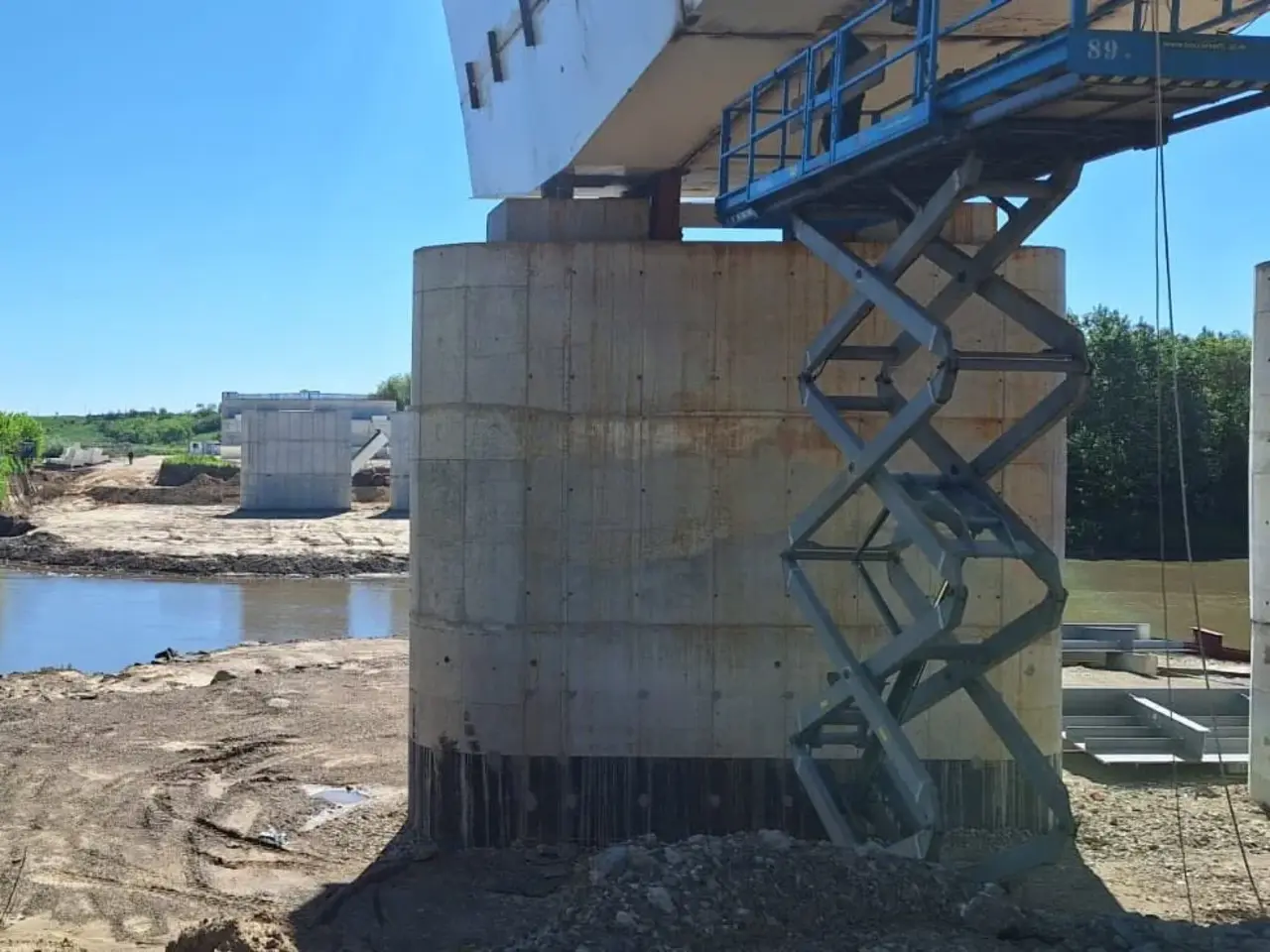
The road bridge over the Prut between Ungheni and Zagarancea — the first motorway-grade bridge over the river in six decades — is nearing completion. One year after the works began, the structure was about 45% complete, and the steel decks are already being mounted on the right bank. According to the Ministry of Transport and Infrastructure in Bucharest, the pair of bridges will be ready “in about four months” — that is, by this autumn.
The less expected news, announced by the same ministry on 16 June, is that a finished bridge does not mean a crossable Prut. To actually cross the river by car at Ungheni, the customs complex, the border control point and the access roads still have to be built — a second phase that, in the best-case scenario, would only be completed in 2028. (We explained the bridge project in detail in last week’s article.)
The bridge and the crossing are two different things
The confusion comes from the fact that “bridge ready” and “crossing open” are separate stages. The contract of about 151.69 million lei (excluding VAT), won by the builder NESS Project Europe, actually covers a whole package: the two parallel bridges (each with two lanes per direction), the connection road and the border control point. The bridge itself — started on 26 April 2025, with an 18-month execution term and a 10-year warranty, its deck manufactured in Satu Mare — is only the first piece. The rest is yet to come.
On the Romanian bank: the customs are contracted, but only just seeking their permit
What comes after the bridge was detailed by the ministry on 16 June:
The Ministry of Transport and Infrastructure, through CNAIR SA, will build the infrastructure of the customs complex, namely the roads, the access gates, the buildings, the halls and the basic utilities. Subsequently, the Romanian Customs Authority and the Border Police will equip the buildings with all the equipment and elements needed for them to function.
Romanian Ministry of Transport and Infrastructure
The problem is the calendar. For the connection road and the border control point, the ministry admits that the building permit is “being obtained.” The construction is estimated at 18 months from the start — so, if the work on the complex begins this autumn, it would only be finished in spring 2028.
On the Moldovan bank: money promised since 2023, but not a single site
If on the right bank the work is at least contracted, on the left one — ours — the second phase is still on paper.
The money exists, at least on paper. As early as February 2023, the Customs Service announced that the infrastructure of the Ungheni–Ungheni crossing on the Moldovan side is funded from European funds: about €7.8 million for infrastructure and almost €4 million for equipment, with the Ministry of Infrastructure and Regional Development (MIDR) as implementer.
And the land, too, is being assembled, slowly, piece by piece. In the spring of 2026, the government took two administrative steps: on 15 April it transferred to the state 0.5634 hectares of forest land from Zagarancea, and through a subsequent decision — signed by Prime Minister Alexandru Munteanu and Deputy Prime Minister Vladimir Bolea — it proposed ceding another 0.3816 hectares, also from Zagarancea, to the National Roads Administration. The plots are, in the document’s words, “located on the site of the construction works of the national road R1 Chișinău–Ungheni–border with Romania (the Zagarancea–border with Romania sector).” The decisions, however, concern only the land transfer; they allocate not a single leu for construction.
And beyond the promised money and the land moved from one ownership to another, there is nothing concrete. As of 16 June 2026, in the public procurement systems (tender.gov.md and mtender.gov.md), on the Customs Service procurement page and in the State Register of local acts, there was no announcement, contract or contractor for the Moldovan customs complex at Ungheni–Ungheni, nor for the Zagarancea–border road sector. In short: on our bank, the second phase has not even been put out to tender.
What it means for the people of Ungheni
For a driver from Ungheni, the practical conclusion is simple and a little disappointing: even if he sees the bridge raised over the Prut this autumn, he will still have to cross into Romania via Sculeni (about 15 kilometres to the north) or via Leușeni–Albița — probably for another couple of years.
The asymmetry between the two banks tells, in fact, the whole story. On the Romanian side, the customs and the connection road are already under contract, with the permit on the home stretch. On the Moldovan side we have the land and the European money, but not a single construction site started. The new transport agreement between Chișinău and Bucharest, whose negotiations were also announced on 16 June, promises “coordinated control” at the border — a single stop instead of two. For now, though, it is a framework on paper, not functioning infrastructure.
A note on the name
Because several are in circulation: officially, the structure is called the “Ungheni (Republic of Moldova) – Ungheni (Romania) road bridge,” and in Chișinău it is called the “Bridge of Flowers,” a reference to the bridges of flowers across the Prut in the 1990s. It is not the “Union Bridge” — that is the name of Romania’s A8 motorway, which is only due to reach it. And it has nothing to do with the “Eiffel Bridge,” Ungheni’s old metal railway bridge, built in the 1870s.
A clarification on the figures, since they are easy to confuse: the 151.69 million lei (excluding VAT) is the contract for the entire package on the Romanian bank — bridge, connection road and crossing point — funded from European funds. “Spring 2028” is an estimate conditioned on the start of work on the customs, not a firm date. And on the Moldovan bank, as of mid-June 2026, no public document showed who is building the customs complex and the access road at Zagarancea, with what money and by when. Until these pieces appear — both on paper and on the ground — the bridge over the Prut remains, for the people of Ungheni, a promise that can be seen from the bank but cannot yet be used.