
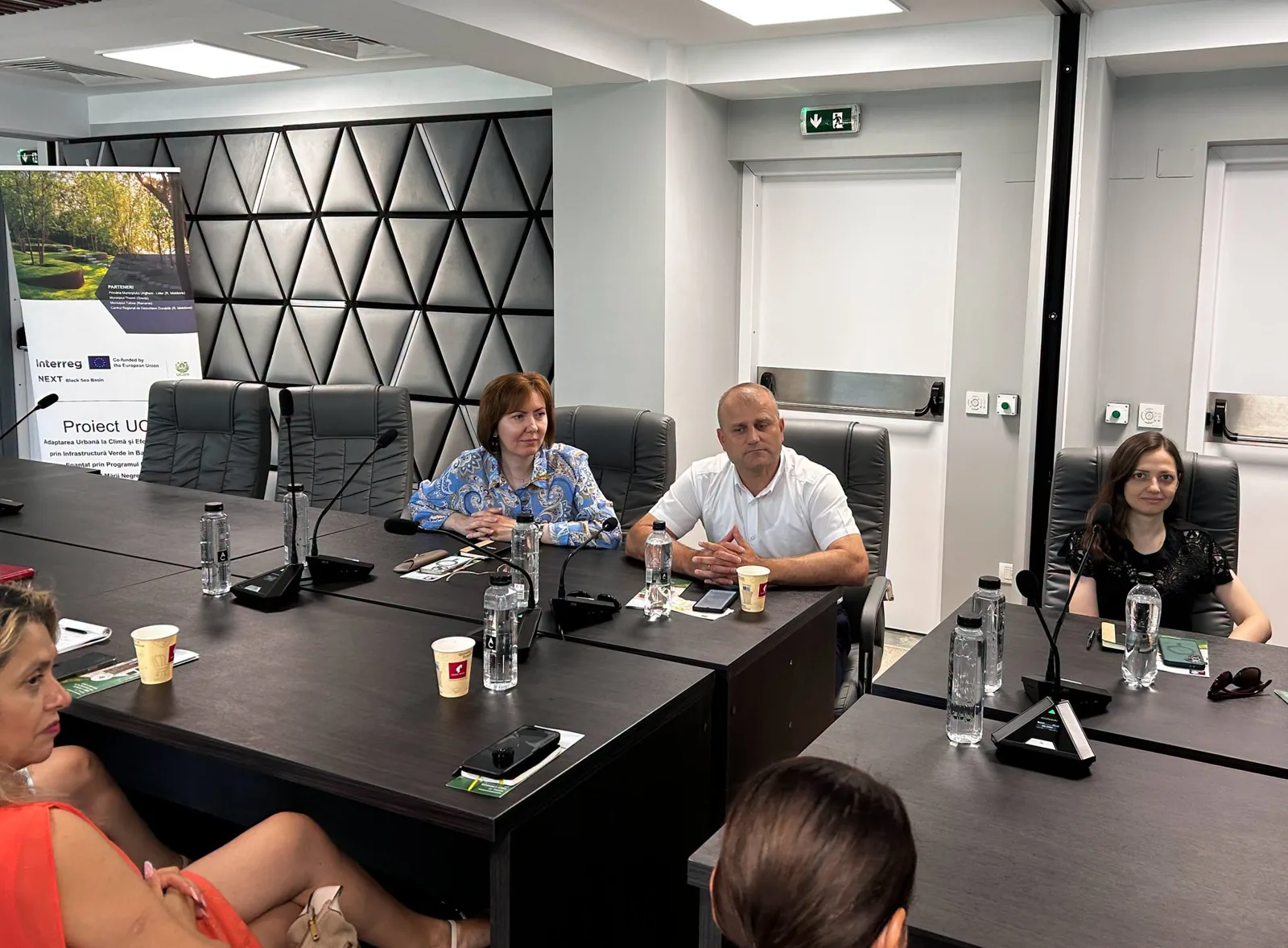
A team from Ungheni Town Hall returned in early August from a working meeting in Tulcea. The reason: Ungheni is leading a European project called UCare, with a budget of almost 1.5 million euros, devoted to a subject that sounds technical but concerns us all in ever-hotter summers — green infrastructure.
Between 3 and 6 August, the delegation took part in Tulcea in a meeting of the “Green Deal Promoters” network, together with the partners from Romania and Greece. We start from there to clear up three things: what “green infrastructure” means, what the project our town coordinates actually is, and why it matters for an ordinary Ungheni resident.
What “green infrastructure” is
The European Commission defines green infrastructure as a network, planned in advance, of natural and semi-natural areas — parks, tree lines, wetlands, green corridors, even green roofs — managed so as to bring the town a range of concrete benefits and, at the same time, to support biodiversity.
The simplest wording came, right here in Ungheni, from an agreement this year between the Town Hall and the environmental researchers of the State University: the services that nature provides are “the benefits it offers the town for free — clean air, the shade and coolness of trees, the retention of rainwater,” while green infrastructure is “the network of green and water spaces: parks, tree lines, wetlands, the river itself.”
The underlying idea: instead of fighting heat and water only with concrete, pipes and air conditioning, the town uses nature as if it were a piece of equipment. A row of trees casts shade and lowers the temperature; a square with soil and grass swallows a downpour instead of sending it all into the sewers; a wetland cleans the water and shelters birds. These are what specialists call “nature-based solutions.”
Why it matters for Ungheni
Because Ungheni has exactly the problems that green infrastructure eases. This summer the town went through yellow and orange heatwave warnings, with temperatures of up to 38 degrees and tropical nights, through a yellow warning for wildfires, while the riverside neighbourhood was, in past years (2008, 2010, 2020), threatened by the Prut’s floods.
This is where the measurable benefits of greenery come in. Scientific studies show that green spaces can cool a town by around one degree on average — and by a few degrees in well-wooded areas — while a densely built-up zone, all concrete and asphalt, can be 10–15 degrees hotter than its surroundings. Trees cast shade and “sweat” coolness; soil and vegetation retain rainwater and further tame floods.
The town is not starting from scratch. Its largest green space, the French Park on the bank of the Prut, covers almost 14 hectares. To this are added the squares downtown, the tree lines and the riverbank — that is, green infrastructure that already exists and that the European project aims to develop and manage better.
The UCare project, in brief
Its full name is “Urban Climate Adaptation and Recovery Efforts through Green Infrastructure in the Black Sea Basin,” in short UCare (code BSB00822). It is funded by the European Union through the Interreg NEXT Black Sea Basin Programme 2021–2027 — a programme of almost 94.5 million euros that links eight countries around the Black Sea, among them the Republic of Moldova, and is coordinated by Romania’s Ministry of Development.
The project has four partners: Ungheni Town Hall — the lead, the towns of Tulcea (Romania) and Thermi (Greece), and the Regional Centre for Sustainable Development in Ungheni. The total budget is 1,467,793.32 euros, of which 90% (1,321,013.97 euros) is European money, and 10% co-financing by the partners. The project was launched in Ungheni in October 2025 and runs until August 2027.
Of this money, Ungheni Town Hall’s share is 685,460.90 euros — almost half of the entire budget and the largest share among the four partners, according to the Municipal Council decision of June 2025, which also approved the local co-financing of 68,546 euros (10%). Ungheni is therefore not simply a guest at the table: it is the one holding the project together.
One clarification, to avoid confusion: in Ungheni, UCare has a green-infrastructure pilot component tied to the French Park area, but it is not the same thing as the park’s regeneration works, worth around 34 million lei, which are being carried out under a separate national project. These are two different sources of money on the same place dear to the town.
What it brings, concretely, to Ungheni
Beyond the terms, the project means tangible things: a network of Green Deal “promoters” (the one that met just now in Tulcea), a green camp for 25 young people from Moldova, Romania and Greece hosted by Ungheni in July, an inventory and mapping of the region’s plant species, climate lessons in schools, a green-space management guide, an online learning platform and demonstration urban gardens. At programme level, UCare provides for two pilot actions — one in Ungheni, the other in Tulcea.
All of this connects to the European Green Deal, the European Union’s plan launched in 2019, which aims for Europe to become climate-neutral by 2050. Cities are at the heart of this effort: they house three quarters of the EU’s residents and produce over 70% of carbon dioxide emissions globally.
What was discussed in Tulcea
At the meeting held in the “Tulcea Hall” of the host town hall, representatives of an architecture office from Tulcea presented the town’s experience in urban architecture and sustainability, while the partners from Thermi spoke about an environmental education centre for children and adults. The programme also included visits to the Măcin Mountains National Park and the Danube Delta Biosphere Reserve, where the delegation saw how protected nature is used alike for biodiversity, education and tourism.
For Ungheni, the stakes are the same ones any resident sees when looking for a bit of shade in July: more trees, better-tended green spaces and a town that is a little cooler and more prepared for the summers to come.