

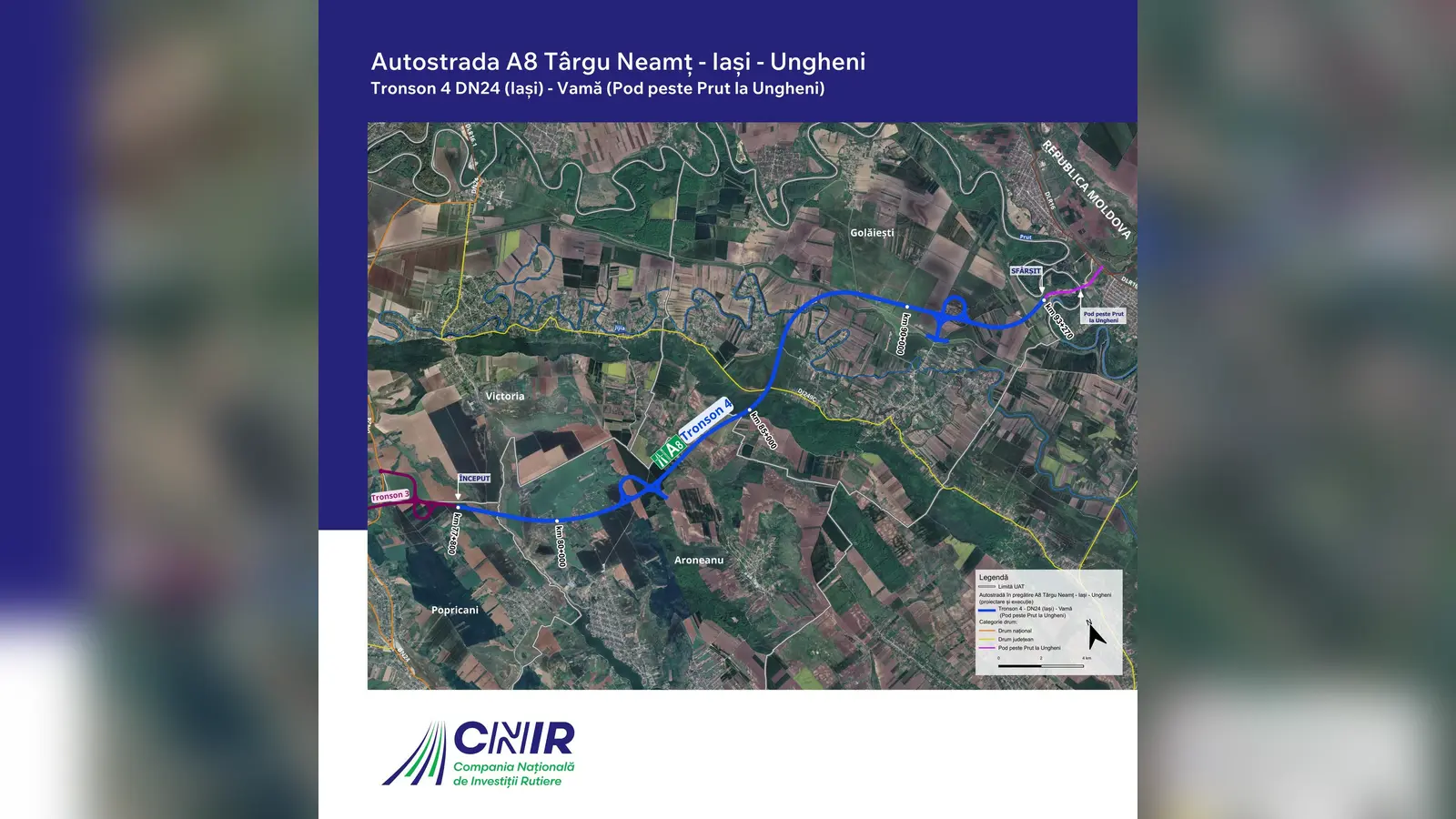
Update — 6 July 2026. The file has taken another concrete step. Romania’s National Company for Road Investments (CNIR) has issued the Design Commencement Order for this section, and the design work itself for the 15.5 km up to the Prut — plus the roughly 5 km on the Moldovan bank, from the bridge to the town’s bypass — begins on 24 August 2026. Priority, according to CNIR, goes to the segment between the Golăiești interchange and the bridge at Ungheni. With this, the clock on the contract’s 46 months (10 for design, 36 for construction) effectively starts. The text below, published on 2 July, remains valid.
On 2 July, in Bucharest, the contract was signed for the final section of the “Union” Motorway (A8) — the segment that comes down from Iași to the Prut and, for the first time, also climbs onto the Moldovan bank. Concretely: 15.5 km of motorway on Romanian territory, plus 4.7 km of motorway built beyond the Prut, from the future bridge at Ungheni to the town’s bypass. These will be the first motorway kilometres in the history of the Republic of Moldova.
The signing was announced by Romania’s National Company for Road Investments (CNIR), which awarded the works to an Italian consortium — Itinera, Saipem and ICM. The contract’s value is 3.57 billion lei, the financing comes through the European SAFE programme, and the planned duration is 46 months (10 for design, 36 for construction). On the same day, in Bucharest, the Republic of Moldova’s deputy prime minister, Vladimir Bolea, and Romania’s interim minister of transport also signed a separate agreement that creates the framework for connecting Moldova to the European TEN-T transport network.
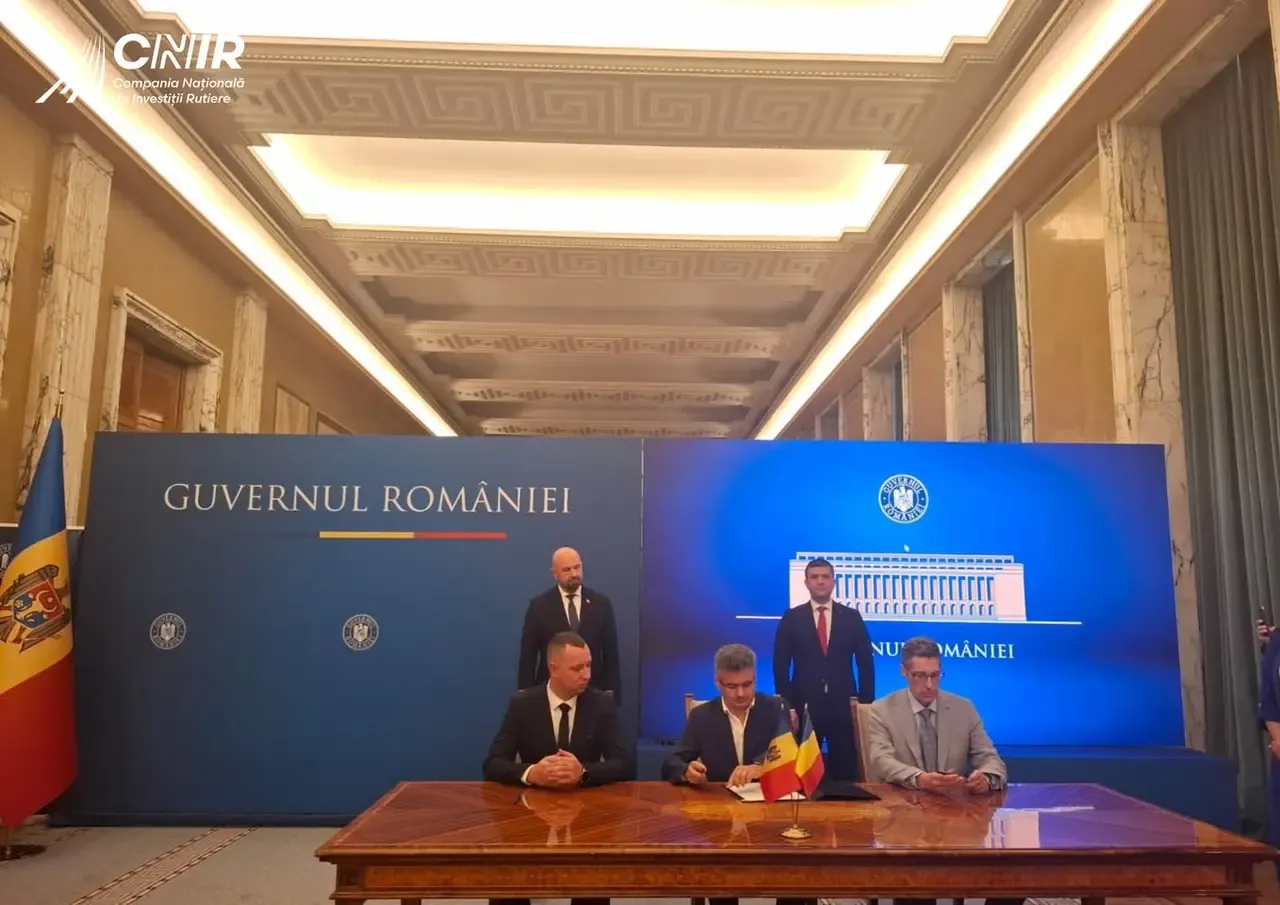
The signing of the contract and the bilateral Romania–Republic of Moldova agreements, in Bucharest, on 2 July 2026. Photo: CNIR
For the reader in Ungheni, beyond the pomp of the signatures, one simple thing matters: the missing piece in the file of our bridge over the Prut has just been put in its place — at least on paper.
What was actually signed
The section runs 15.5 km on the Romanian side, from the road towards Iași to the Prut, with a demanding technical route: 14 bridges and overpasses, two tunnels (the one at kilometre 83 is 1,760 metres long) and two interchanges, one of them linking to the future Regional Hospital and Iași Airport. CNIR says it prioritised the 2.77 km segment between the Golăiești interchange and the Ungheni bridge, which is meant to be ready in 18 months.
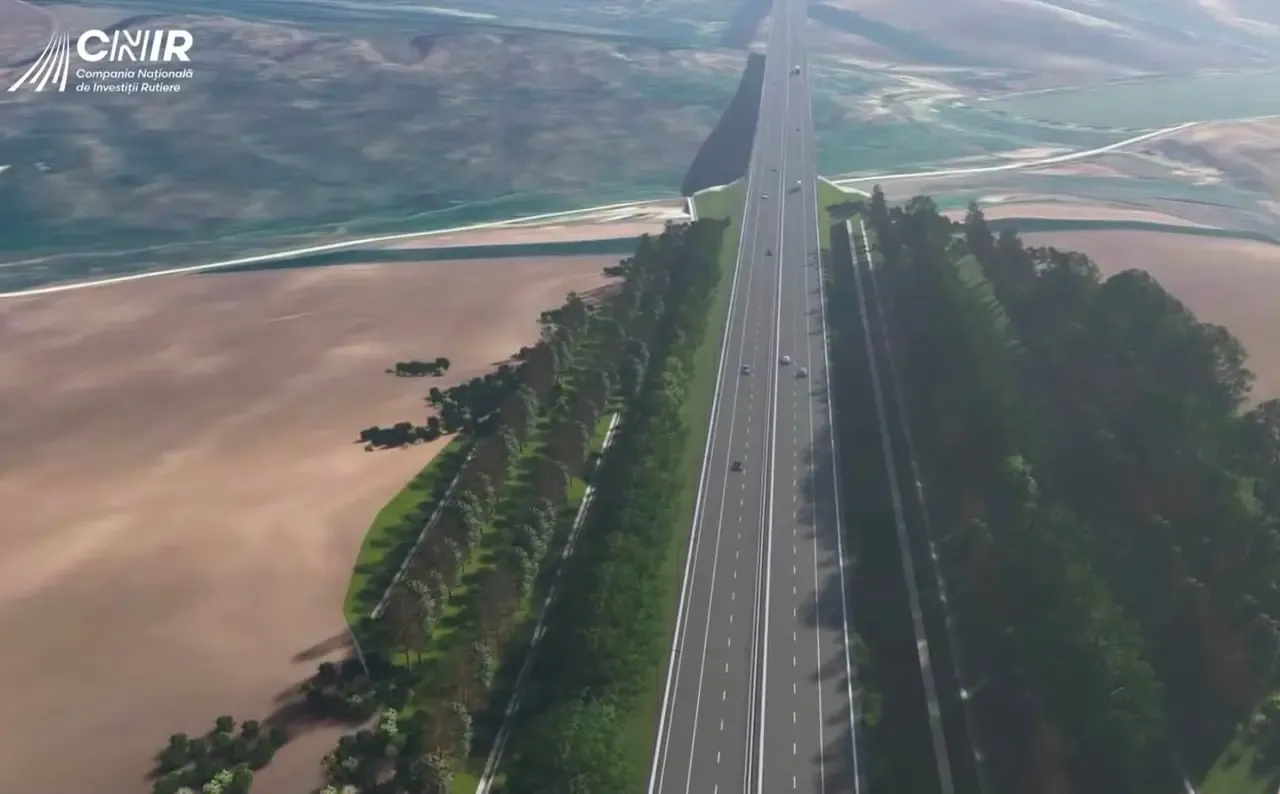
The Golăiești interchange (km 90+790), near the Prut end, in a project rendering. Source: CNIR
The last kilometres of the A8 Motorway up to the Prut will be built, but also the first kilometres of motorway towards Chișinău, in the Republic of Moldova. The SAFE instrument is proving a success, and we will make every effort to meet the planned deadlines.
Gabriel Budescu, director general of CNIR
The phrasing “first kilometres towards Chișinău” needs a nuance correction. According to the Ministry of Infrastructure in Chișinău, the Moldovan segment of the contract means 4.7 km of motorway — from the bridge to the Ungheni bypass, with an interchange and an overpass across the railway — plus 1.1 km of connecting road towards the future Berești Logistics Centre. Not towards Chișinău, then, but up to the edge of the town of Ungheni.
Who pays: Romania, in full
The truly new element — and the one that changes the arithmetic compared with what we knew until now — is who pays for the works on the left bank. The answer: the Romanian side, in full.
According to the MIDR, the roughly 64 million euros for the works on the territory of the Republic of Moldova are covered entirely by Romania, through the SAFE funds, and the tender was held jointly with the one on the Romanian side. SAFE is a European financial instrument that came into force in May 2025, which can lend states up to 150 billion euros and which finances dual-use civil infrastructure as well — roads and railways used both for economic and for military mobility. In other words, the first metres of Moldovan motorway enter Moldova on European money and on European security logic.
In our June articles about the Ungheni bridge, this was exactly the gap we were flagging: on the Moldovan bank “there is still neither a contractor nor a contract”. Today’s contract partly fills that gap — for the motorway. The customs post and the crossing point remain a separate story.
The timeline, in the Prime Minister’s words
Beyond the contract’s figures, Romania’s Prime Minister Ilie Bolojan pointed out, in the announcement of the signing, two things that matter directly for Ungheni: that between Pașcani and Ungheni a single section remains without a construction contract — with litigation that should close by autumn — and that the bilateral agreements signed the same day include the financing of the Ungheni road bridge, given as ready “this autumn”.
These are the 15.5 kilometres of the Iași–Ungheni section and another 5 kilometres of motorway beyond the Prut, towards Chișinău. […] From next spring, work will be under way on all four sections. By 2030, all works must be completed, in line with the SAFE financing contract.
Ilie Bolojan, Prime Minister of Romania
“Towards Chișinău” remains an optimistic phrasing — the motorway financed now stops at the Ungheni bypass. What is new, however, is the publicly assumed horizon: 2030 for all four sections between Pașcani and Ungheni, for the first time with a clear target date for the road meant to link Iași to the Prut.
Why it matters for Ungheni
Ungheni is, historically, the “socket” through which Moldova connects to the west: the railway has passed through here since 1870, and the gas pipeline from Iași also entered through here. Now the road is being added. The motorway is meant to “land” right next to the town, at the bypass and at the future logistics terminal at Berești — a multimodal complex designed at the Berești station, spread over around 18 hectares, with an estimated capacity of 200,000 trucks per year. Together with the road bridge over the Prut and the electrification of the Iași–Ungheni railway, a triad would take shape — road, train, terminal — all of which links up right here.
That is the optimistic part. The realistic part is that all three pieces have long and misaligned timelines.
Reality check: the bridge is ready before the roads
The Ungheni–Zagarancea road bridge is meant to be structurally ready towards the autumn of 2026. But, as we explained, a finished bridge does not mean a crossable Prut: the customs post, the border control point and the connecting roads still have to be built — a second stage with a 2028 horizon. On top of this the motorway is now layered, with its 46 months of design and construction.
On the Romanian side, too, the A8’s history is one of postponements. The very section signed now was blocked for months by tender challenges, rejected only on 16 June. Across the motorway as a whole, Romania’s specialist press wrote, in the summer of 2025, that more than half the route “is not ready even on paper”. And beyond Ungheni, towards Chișinău, there is still no financed motorway at all — only a feasibility study for the railway.
There remains, in addition, the silent backdrop of any discussion about the district’s development: the population of Ungheni district fell from around 96,000 inhabitants in 2014 to 74,500 in 2025, according to provisional data from the National Bureau of Statistics. The question that matters for Ungheni residents is not whether the motorway will reach the Prut — today that has become more likely than ever — but whether the road–train–terminal triad will turn Ungheni into a node where something stops, or merely a corridor through which traffic passes more quickly.