

Secretary General of the Government, Alexei Buzu presented the local public administration reform in Brussels on 2 June as “a key element in modernising the state,” according to a statement by the State Chancellery. Nationwide, local authorities have already adopted more than 700 decisions to launch voluntary amalgamation. Behind the diplomatic phrasing lies a change that could redraw the administrative map of Ungheni district: a 3,000-resident threshold for a viable town hall. Below it, by a newsroom calculation, sit 23 of the district’s 33 town halls.
Why the reform: the numbers of fragmentation
The government’s case rests on data, laid out in the reform’s concept paper published by the State Chancellery. Of the country’s 892 town halls, 776 — that is, 87.6% — have fewer than 3,000 residents. The average is 2,708 residents per town hall, against 4,685 in the European Union. Only 47 town halls, one in twenty, can finance themselves; the rest depend on transfers from the state budget, which cover 60.5% of revenue on average. And in small communities, almost a third of the budget — about 30% — goes to running the administrative apparatus rather than to services for people.
Above all, the demographics. Between 2014 and 2024, localities with fewer than 3,000 residents lost 32.7% of their population — more than twice the national average. The smaller the village, the faster it empties.
The map of Ungheni: 23 of 33 below the threshold
Ungheni district has 33 first-tier administrative-territorial units — one municipality, one town and 31 communes and villages with their own town hall. To see how many clear the proposed threshold, the newsroom used the public population figures on which representation on local councils was set (National Bureau of Statistics estimates as of 1 January 2019).
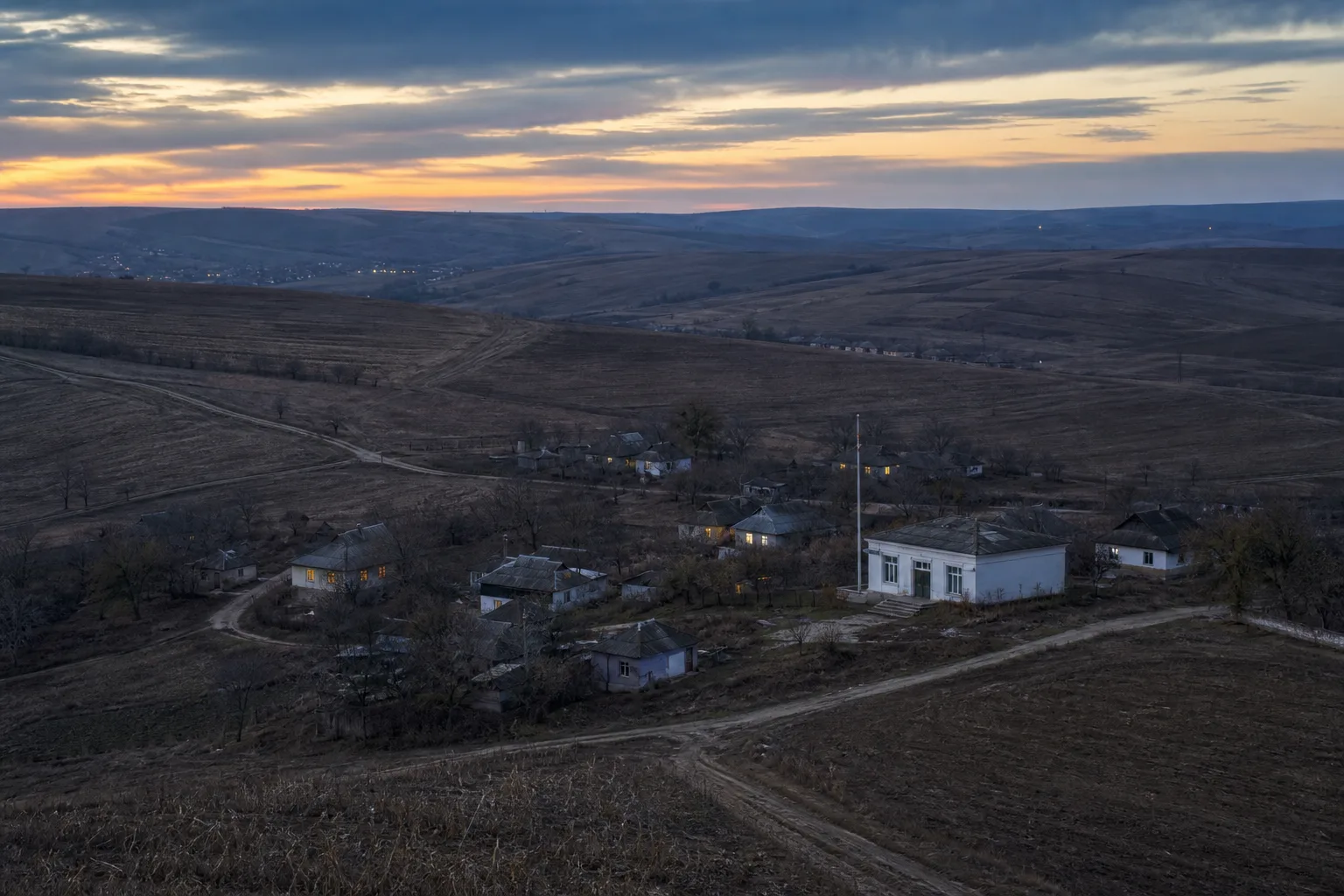
The result: only three town halls exceed 5,000 residents — the municipality of Ungheni, Pârlița and Sculeni. Another seven fall between 3,000 and 5,000. The remaining 23, or seven in ten, are below the 3,000 threshold. Of these, 11 have fewer than 1,500 residents, and three villages — Cornova, Năpădeni and Măgurele — drop below 1,000. Since these figures predate the 2024 census, which confirmed a sharp decline in the villages, today’s real picture is most likely even more severe.
What the reform proposes
The central pillar remains voluntary amalgamation, backed by financial incentives: transfers to prepare the process, for infrastructure and to support the budgets of merged town halls. The concept paper also provides for a stage of mandatory amalgamation, with the 3,000 threshold guaranteed by the end of the reform. In localities that lose their town hall, the government promises Unified Public Service Centres — a single counter offering more than 600 services, housed in the buildings of former town halls. Separately, the 32 districts would be reorganised into 10 larger regions, comparable to the European statistical level NUTS 3.
Voices from the ground: five villages that want to merge
In Ungheni district, the abstract calculation has already become a concrete conversation. Five localities — Florițoaia Veche, Cetireni, Rădeni, Unțești and Alexeevca — are weighing a merger. The reason the mayors cite is not ideological but financial. “We had a project call for 2026 that we lost because we have fewer than three thousand residents,” says Dumitru Frasin, mayor of Florițoaia Veche (1,379 residents). “Since we are a town hall of 1,297 residents, we are too few, and we cannot apply for large projects,” adds Teodor Gorincioi, mayor of Cetireni. And Nicolae Sorotinschi, mayor of Unțești, sees a merger as a way to apply for funding of 5–7 million lei.
The other side: the mayors’ association sounds a warning
The reform, however, is not accepted unconditionally. The Congress of Local Authorities of Moldova (CALM), which represents mayors, supports modernisation through “evolutionary models, decentralisation and voluntary mergers” — but rejects forced amalgamation. “We are not against the reform, but it must be very carefully thought through, and villages must decide voluntarily whom to join,” said CALM President Tatiana Badan.
Through CALM, mayors are calling for communities’ right to a local referendum when a town hall is set to be closed, thorough planning before implementation, and pay rises for administrative staff — otherwise, they warn, town halls will be left without personnel regardless of any merger. Some localities have already voted against and say they will file complaints with the State Chancellery.
What remains unanswered
The reform sets a reality hard to dispute — villages that are emptying out and town halls that can afford little more than their own apparatus — against an equally real fear: that services will move further from the citizen, and that decisions will be taken over communities’ heads. For Ungheni, the practical questions are only beginning: where the merged town hall will be based, how people from the small villages will reach services, and whether the mergers will be validated by consulting residents.
This article draws on the State Chancellery’s statement, the concept paper of the local administration reform, the 2024 census data, and the public positions of mayors and CALM. The calculation of Ungheni district town halls below the 3,000-resident threshold belongs to the newsroom and uses the population figures published for 1 January 2019; we will update it once locality-level data from the 2024 census is published. The newsroom will follow the amalgamation decisions adopted by the district’s local councils.