

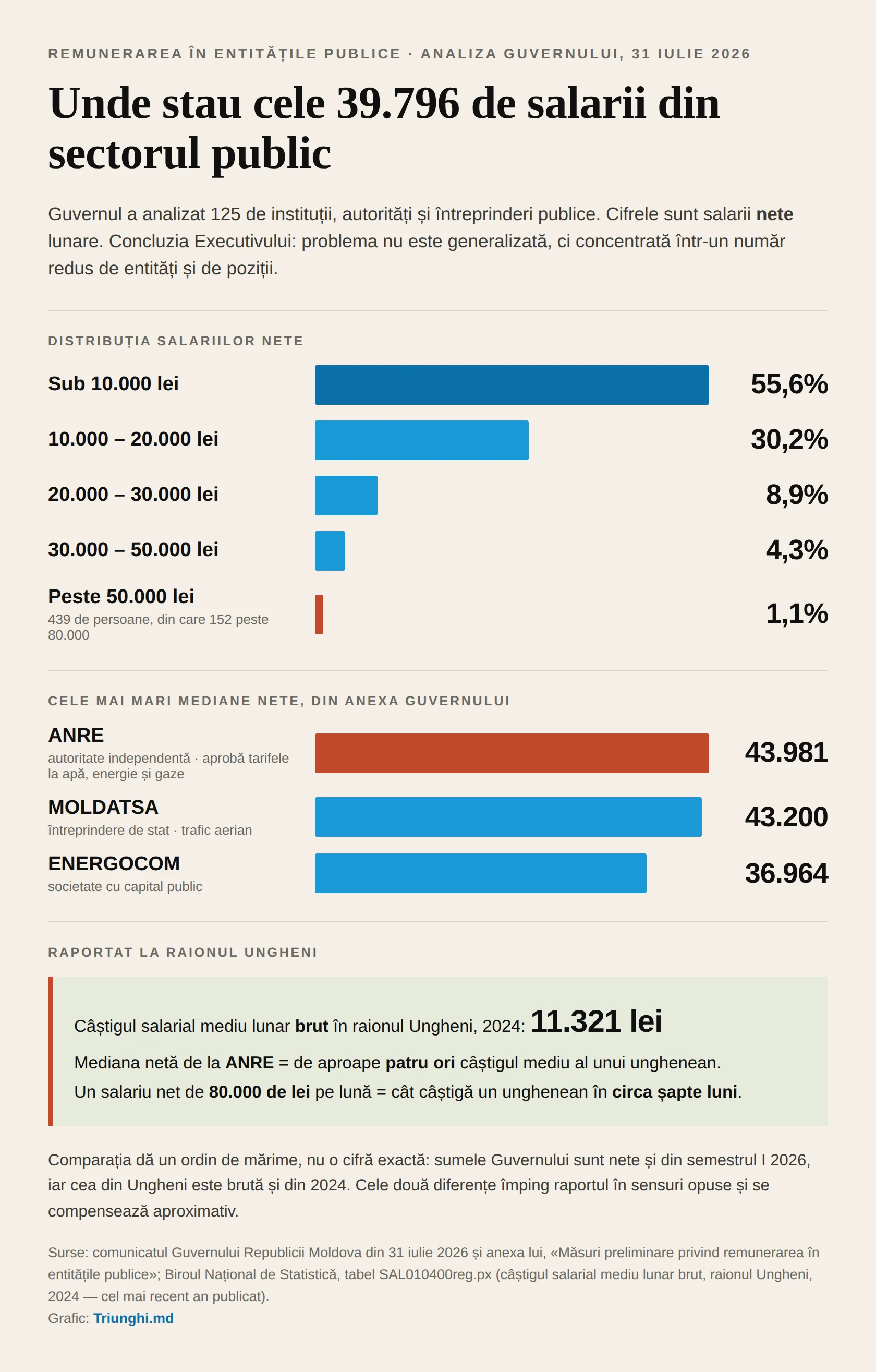
The Government has counted the salaries in the public sector and published the figures on 31 July. At the request of Prime Minister Vasile Tofan, the Executive analysed pay in 125 public institutions, authorities and enterprises, with 39,796 employees in all.
The conclusion drawn by the Government itself is that “the problem is not generalised, but is concentrated in a small number of entities and positions”. The figures bear it out: 85.8% of those analysed have net salaries below 20,000 lei a month, and more than half — 55.6% — below 10,000. Average net pay across the whole perimeter is around 11,900 lei, and the median around 9,000.
The top, however, is very high. 439 people, that is 1.1% of the total, earn more than 50,000 lei net a month. Of those, 152 exceed 80,000 lei net.
Who actually decides the tariff paid in Ungheni
The annex to the press release contains a table of the entities with the highest median salaries. First on it is ANRE, with a net median of 43,981 lei — meaning that half the agency’s employees earn more than that. Next comes MOLDATSA, the state enterprise for air traffic, with 43,200 lei.
The median describes the middle, not the top, and the difference matters: ANRE has 36 posts above 50,000 lei and 6 above 80,000, whereas MOLDATSA, with a slightly lower median, has 102 and 60 respectively. The median is estimated by the Government by interpolation, in bands of 5,000 lei, and the values may be updated after validation with the entities that reported.
ANRE is the agency that approves the water tariffs paid by Ungheni residents: 25.17 lei per cubic metre for drinking water and 14.84 lei for sewerage, in force since 14 July. It is not the local council that sets them, but the agency, under Law no. 303/2013. ANRE also approves the tariffs for electricity and natural gas.
The link stops there, however: nothing in the Government’s analysis connects ANRE salaries to the size of the tariff. In the agency’s own calculations, 77.2% of the tariff paid in Ungheni are staff costs — those of the local operator, not of ANRE. What remains is something else: the institution that decides how much a household in Ungheni pays for water sits first in the table drawn up by the Government, and the Executive says it cannot change its pay policy by administrative order.
The local operator is, in fact, outside this discussion. ‘Apă-Canal Ungheni’ SRL is wholly owned by the municipality, not by the state, and the Government explicitly limits its competence to government agencies, subordinated institutions, state enterprises and companies in which the state is founder or shareholder.
What that amounts to in Ungheni
In Ungheni district, average monthly earnings in 2024 stood at 11,321 lei gross — the most recent year published by the National Bureau of Statistics. The district ranks 9th out of 35 territories, slightly above their average, but at around 81% of the national average.
The ANRE median is therefore almost four times the average earnings of an Ungheni resident. A net salary of 80,000 lei a month is what an Ungheni resident earns in roughly seven months; one of 50,000, what they earn in roughly four and a half months.
The comparison is not exact. The Government’s figures are net and from the first half of 2026; the Ungheni figure is gross and from 2024. The first difference makes the ratio look smaller than it is, the second pushes it up. They roughly cancel each other out, so the order of magnitude holds — months of work for one month’s salary — but the figures should not be read down to the decimal.
Where the high salaries are
Of the 439 posts paying more than 50,000 lei net, 180 are in the independent regulatory authorities, 130 in state enterprises, 51 in companies with public capital, 47 in public institutions and 31 in project implementation units.
The four independent authorities — the National Bank of Moldova, the National Commission for Financial Markets, the National Agency for Energy Regulation and the National Agency for Communications Regulation — account for just 2.5% of the perimeter analysed, with 1,005 employees. Their pay level is, the Government writes, “more than twice as high as the rest of the public institutions and four and a half times higher than the state enterprises”. The National Bank and MOLDATSA together account for 226 of the 439 posts — more than half.
The document also states the part that cuts the other way: some institutions “compete for rare skills – air traffic controllers, IT and cybersecurity specialists, financial or energy experts”, and there “a high pay level can be justified”. The problem appears, the Government writes, when pay is not transparent, is not tied to measurable objectives, is approved by the person who receives it or cannot be explained by the complexity of the post.
The state must be able to attract professionals, including in highly specialised fields. But a high salary has to be explainable: through the complexity of the work, results, responsibility and integrity. Vasile Tofan, Prime Minister
What changes and what stays unpublished
The measures are preliminary for now: the document says the package “will be transposed into Government decisions, decisions of the founders and draft laws” and that the Government is waiting for proposals before the normative acts are adopted.
They run along three lines. The Public Property Agency and the founding authorities will check around 100 of the largest pay packages — fixed salary, variable part, material aid, bonuses, benefits, payments from profit. For the duration of the check, for posts that exceed the equivalent of three average economy-wide salaries, it is proposed that the approval of new bonuses be suspended. The heads and deputy heads of public institutions, project implementation units and companies with public capital whose pay exceeds the set threshold will no longer receive annual material aid.
The second line is transparency: a single platform with the posts, the salary bands and the components of pay, plus quarterly reporting for enterprises with public capital. The third concerns governance: boards with, as a rule, no more than three members and a maximum of five in justified cases, a single board and no more than two terms for a person representing the state, a cap on the state representative’s monthly allowance at one national minimum wage, the abolition of the boards of auditors and a ban on an administrator approving additional payments for himself, directly or indirectly.
The full list of the 125 entities analysed is not published. The annex gives the table of the top entities by median and the breakdown across the five segments, but not the name of every institution in the perimeter. Without the whole list it cannot be established which of the institutions and enterprises operating in Ungheni district fall under the check.