
Milk producers in Moldova — and so in Ungheni district too — can once again claim public money for the milk they have sold. The Agency for Interventions and Payments in Agriculture (AIPA) opened, on Monday, 6 July, Call VII for direct payments in livestock farming, with applications accepted until 14 August. It is a useful and expected measure — but, read through the district’s figures, it also shows how few of those who keep cows can actually use it.
What the money is for
The support is granted per kilogram of milk sold: cow’s, sheep’s and goat’s. It counts milk sold in the second half of last year — more precisely between 1 July and 31 December 2025 — while applications run from 6 July to 14 August 2026, according to the Ministry of Agriculture and Food Industry. The money comes from the Republic of Moldova Growth Plan 2025–2027 and the National Fund for Agriculture and Rural Development.
How much is it, concretely, per litre? AIPA has not published a distinct amount for this call. The rate from the regulation in force applies — Government Decision no. 492 of 2023, which sets the per-kilogram direct payments: around 3 lei for a kilogram of cow’s milk and 5 lei for sheep’s or goat’s. For a farm delivering a few dozen tonnes a year, it adds up to a sum that matters.
Who can apply — and why it matters
Here is the filter. The support does not go to just anyone who milks a cow in the yard. To file the application, the farmer must have a veterinary-sanitary authorised livestock holding, no arrears to the public budget, membership in a professional association, and must not be in insolvency proceedings. The file also requires proof that the milk was delivered to processors (or processed at the applicant’s own authorised unit), with quantities entered in kilograms on the invoices.
These are natural conditions for a payment out of public money, but they are what decides, in practice, who is left out. And in Ungheni district, the figures show a wide gap between “who keeps cows” and “who can get the subsidy.”
1,738 cows, but most in people’s yards
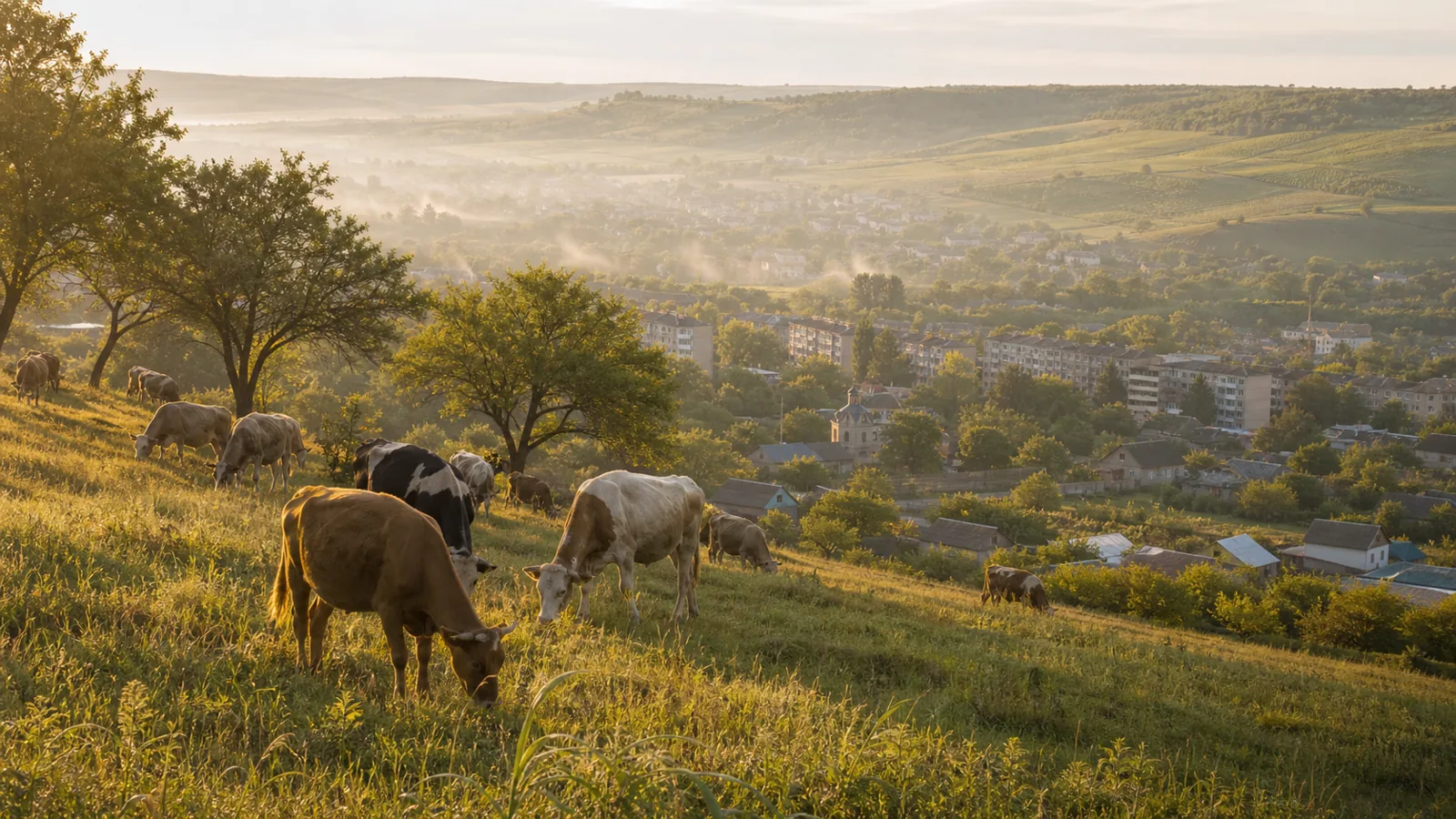
On 1 January 2026, Ungheni district still counted 2,681 cattle, of which 1,738 cows, according to the National Bureau of Statistics. It is a herd in long decline: in 2007, the district had 6,381 cows — more than three times as many.
More important for the subsidy’s story is where these cows are. Of the 1,738, only 195 are at agricultural enterprises and peasant holdings — that is, at the farms that can, in principle, be authorised and file an application. The remaining 1,543, almost nine in ten, are in household holdings: people who keep one or two cows and sell the milk without veterinary-sanitary authorisation and without membership in any association. For them, aid “for milk producers” usually stays outside the door.
At the farms that really do produce for the market, the yield has risen visibly: a cow gave, on average, 4,792 kilograms of milk in 2025, against 2,212 kilograms in 2023, the same statistics show. That is, most likely, where the bulk of this call’s money will go.
Where to file the application
Applications and documents are filed at AIPA’s territorial directorates. For Ungheni district, the territorial directorate is in the town, at 7 Națională Street (telephone 0236 25249). The application template and the full list of documents are published on AIPA’s page dedicated to per-kilogram direct payments. The deadline is 14 August 2026 — those who want the money for milk sold last year have a little over a month.